Auto-SummaryThe post discusses optimized methods for growing mushrooms, focusing on clean MS genetics, cracked corn grain preparation, bulk preparation and casing with coir and beefy tub tek, spawning techniques, and fruiting conditions. It also mentions potential improvements such as adjusting soak times for cracked corn, using AIO bags, adjusting pasteurization temperatures, and providing more frequent FAE (Fresh Air Exchange) for pans. The post encourages the user to take things step-by-step and seek feedback along the way.
I dug this back out of the manure thread. As I think it is a good list honestly. And there's a couple of things I want to touch on specifically because they've become SOP for some folks, and might not be optimal SOP.
Dr. Smoke said:
PLATES
- The first goal is to get clean MS genetics to grain as soon as possible.
- Look for the fastest growing sections. You do not want the thickest growth as often times the thick growths overlay later on -- fast whispy growth is what you want.
- Take first transfers to new agar. Then maybe again. Then to grain.
- Inoculate grain spawn with the dish themselves, cutting into squares with a flamed scalpel.
I removed the bit about peptone as we've already went over it. The rest of this looks good. The only minor thing I would say is getting MS to grain as fast as possible can trip folks up. Cyans can be very aggressive so often we see folks send stuff early thinking that's best practice, but it turns out it's not clean, they get one flush and then it contaminates.
This isn't on you, though, the practice of sending early has sort of evolved over the last year. And Baba pointed out that he thought folks might be jumping the gun. Also, having talked to a few cultivators whose opinions I trust, and now having seen Faht's amazing clone grow (which I'm quite jealous of btw), I don't believe that pans are so vulnerable to senescence that send it early beats out send it clean. And that overstressing send it early tends toward more folks sending it dirty. If that all makes sense.
Quote:
GRAIN - cracked corn - derived from tree frog's science research
- Cold soak cracked corn for 24 hours in a bucket with distilled water then pour that bucket into a strainer bucket and let it strain over night and some of the next day. Occasionally stir the grain around until all the surface moisture is the same (pretty much dry).
- Load PC and sterilize. Cover the (loose lid) grain jars with foil and PC for 2 hours.
- 2-3 days after inoculation when the myc is moving off of the agar wedges, give the jar a single shake. Then slowly roll the grains around for about 1 minute.
- When the jar has colonized 1/3 to 1/2 of the way, repeat the shake and roll and then let the jars fully colonize from there.
- Once fully colonized the growth may look very fine and whispy or it might be a little thicker. Both are good but you don't want marshmallow looking myc. It will bruise in the jar. (don't mistake it for contamination)
I'm not sure that a 24 hour soak is going to be sufficient to hydrate cracked corn. I haven't worked with it to know. And I would suggest doing it in AIO jars or bags, as it's likely to clump up in jars.
I would also suggest washing and rinsing it. Feed grains are dirty and often corn is covered in mycotoxins which may cause issues later on even if the substrate and grains colonize okay.
Quote:
BULK PREP AND CASING - Beefs Beefy Tub Tek
https://www.shroomery.org/forums/showflat.php/Number/28558116/fpart/1/vc/1
- Coir for reptile bedding is best. Gardening coir is lower quality.
- Moisten and pasteurize the compost in quart jars, no lid. Get a 10" pot. Put in water up to the substrate. Heat on Medium and at 150F, turn it down to 1/4. Go for 3 hours. Check regularly to ensure temp is at 155F.
- Weigh the brick in grams and multiply that figure by 4.25 for weight of water in grams to be added to coir.
- Put big pot on scale and tare. Put distilled water into the pot, to weight.
- Boil water. Pour water into bucket with brick. Put lid on. Do NOT shake it. Use when cool. (after shaking it a bit) Scoop a quart out of each bucket, and set aside for pseudo-casing.
- Mix coir and manure thoroughly together, 66%/33% Ps. or 50%/50% Pans. The main thing is to keep the mix from getting soggy so it stays well aerated.
- Divide into two buckets, by weight.
Just a couple of things, you can pastuerize at 140f, two hours is plenty. 130f is the optimal range for beneficial microbes to multiply, and 140f is a good range to kill competition. 155f will actually slow down the proliferation of beneficial bacteria. And it will put you a bit closer to sterilization temperatures (though it's still a solid 15 degrees lower so likely safe). Anyway, I do 140f now as I had an accidental partial sterilization over winter trying to run them at 160f.
All of that said, again I would suggest AIO bags or jars if working with cracked corn.
Quote:
SPAWNING
- Break up the spawn and put one quart into each bucket. Break up any remaining clumps. Put lids on, shakea shakea shakea.
- Pour each bucket into a tub. Thicker sub gives more flushes.
- Use a rubber tile float to level and compress the substrate. Don't pack with all your might, just be -firm- and pay special attention to the edges. I find that if I pack the edges well, I don't get side pins at all and I don't need a liner.
I wouldn't compress the pans. But that's just me. I haven't done side by sides with them yet. And I would probably use more grains for both projects. Usually folks do like 4 or 5 qts to one brick of coir for Ps. For Pans you can half that.
Quote:
- Unmodified tubs: Put the lid on: Let the substrate colonize by cutting Fresh Air Exchange to almost zero.
- Just set it and forget it until its time to monitor surface conditions. No, opening your tub won't contaminate it.
- Let the sub colonize for ~10 days (at about 72°F). Spray every day. Healthy pan substrate will smell similar to almonds and very earthy. It should smell clean in a very obvious way.
This looks good for the Pans. The Ps. you won't need to spray every day, only if it looks dry. Also, you'll want more FAE for the Pans (hence needing to spray).
Quote:
FRUITING
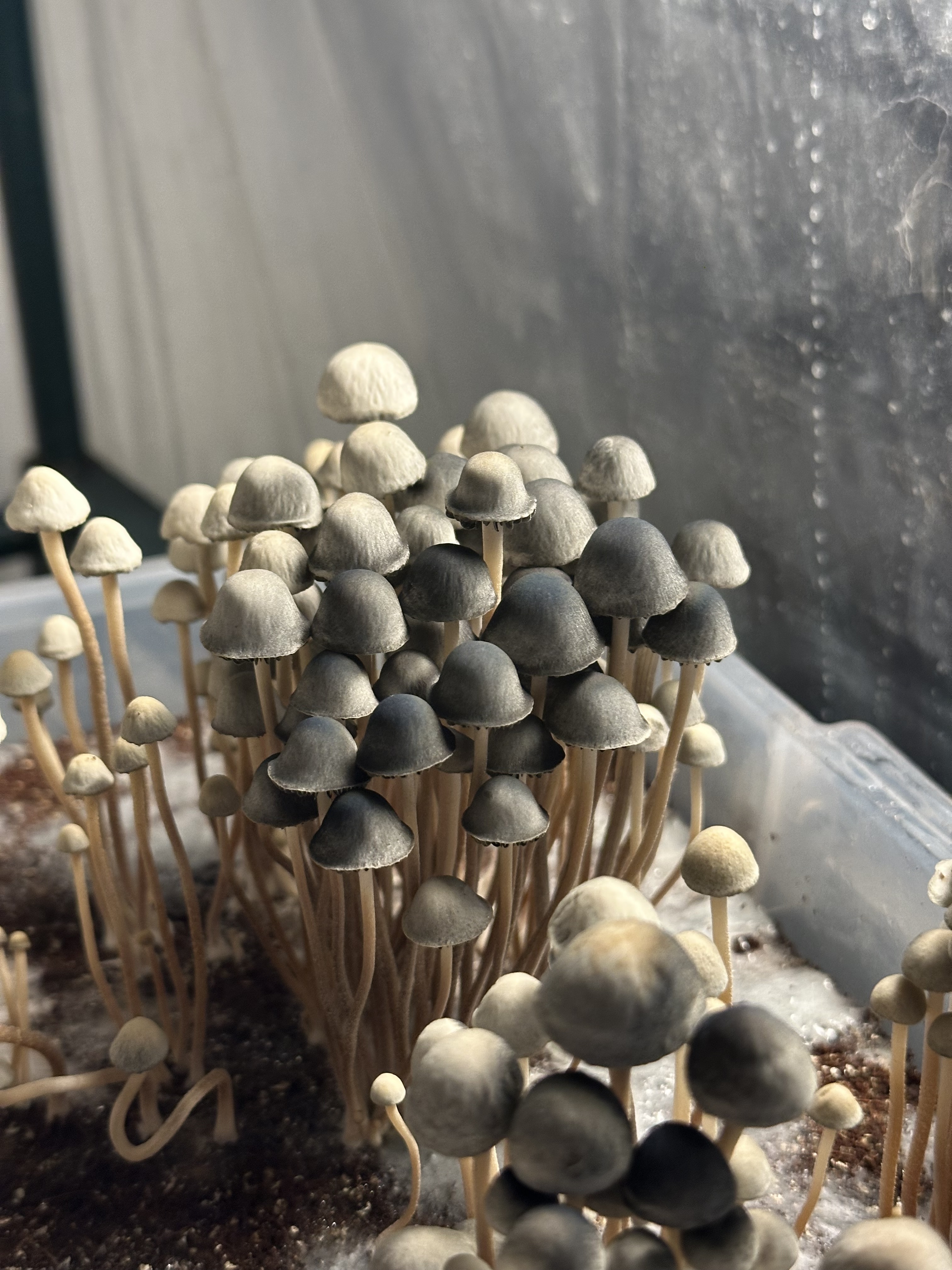
- Successful fruiting of pan cyans requires the understanding of these factors: temperature, fresh air exchange (FAE), humidity, evaporation and surface conditions.
- Pan cyans like temps in the 76-80°F range. If I could lock in a temp perfectly, I would have it exactly 77°F at all times.
- Pan cyans thrive in a high humidity environment. However, evaporation is a major pinning trigger. And evaporation cannot occur efficiently if your tub is always near 100% relative humidity (RH). I just open up my tub 3-6 times per day and blow the tub out with the inline fan from my fogger.
- Unmodified tubs: Put the lid on cockeyed to allow Fresh Air, but keep humid. Many times "why am I not getting pins?" is answered by cycling dryer air into the tent more frequently. I will typically hand-water the casing with a syringe once per day. When adding distilled water, you just want the casing to glisten - where you can see it holding water - and not just damp.
- Once pins have arrived it's important to keep things a little more wet. I will usually crank the humidity a bit and be more aggressive with hand-watering the casing layer. I use a 60ml syringe for this and only use distilled water.
Evaporation is important because Pans use a lot of oxygen and like very high humidity at the substrate surface. 100% humidity is saturation, that means no air (oxygen). When this happens, the tray will stall, just like in a cryovial when we cover a wedge with water for storage.
As we introduce oxygen, we're also removing co2, which makes the environment less hospitable to competition and naturally causes evaporation and a humidity drop, especially at higher temperature ranges. So, we'll need to replace the lost water, both in the casing if needed, and in the air. Either by misting or using a fogger.
In other words, evaporation isn't the thing itself (oxygen, high temperatures, and high humidity). Though it's a good indication that the thing itself is dialed in. Correlation vs. causation.
Storage looks good, so I'll remove that section. And the only thing I can suggest on the poke cloning is to go to brf pucks rather than plates, as it will cut way down on bacterial contamination. You can do very small pucks on plates even (or in little pp5 slime cups is how I do it).
Anyway fam, I'm going to give you some encouragement on your list. You have read and thought things through, and you're asking for feedback on it. Those are positive things.
That said, it will be easier to take things one step at a time. And ask for feedback along the way, which is why I wanted to point you to this thread.
No plan survives contact with the enemy and all of that (not that pans are our enemies, but bacteria and mold certainly are).
So, I would encourage you to hold your plan loosely. And as you go along, continue to post in this thread if you have questions, want us to look at your plates or jars, or whatever. And that will also help you get better feedback, as when a post is very long most of us tend to skim, especially as we've all been wired now for the constant dopamine drip from our electronics.
And, there are a lot of very helpful folks who frequent this thread. Even the shitposters tend to be helpful when they're not firing one off to keep themselves entertained. So, don't let the signal-to-noise ratio kill the vibe fam.
It's just the shroomery, and sometimes it feels a bit hostile. But you have done your homework which is what is encouraged. Just take it a step at a time now that you have an idea of what direction you need to go. And we'll be here to help you along the way 
--------------------
And if I only could
I'd make a deal with God
And I'd get him to swap our places
I'd be running up that road
Be running up that hill
With no problems
|


 Threaded
 Previous
 Index
 Next


 Smellyhobbit


 Mr Piggy

 Dkeppel


 [Re:
 Edit
 Reply






 1 2 3 4 ... 91 92 )
 Hindsight

 Bra

 Huskies

 Acid-Fast
 rob_531
 sancho