- 1932: Claudio Naranjo is born
Quote:
Erowid Character Vaults
Claudio Naranjo
Nov 24, 1932 - Jul 12, 2019
Summary
Claudio Naranjo was a Chilean psychiatrist and author who wrote nearly two dozen books, many of which were published in numerous languages. In his youth he was trained in classical music. He obtained his medical degree in Santiago de Chile, going on to study medicine, psychology, and spirituality at Harvard, U.C. Berkeley, and the Esalen Institute. At Esalen he apprenticed under the father of Gestalt therapy, Fritz Perls. Protoanalysis, Naranjo's method of describing personality types, eventually developed into the well-known Enneagram system.
In 1962, after becoming inspired by a Harvard economic botany exhibit that displayed various psychoactive plants, Naranjo was assisted by the museum's curator, Richard Evans Schultes, with his desire to research yagé use in the territory of Putumayo in Colombia. Once he was in the Amazon, hoping that it would help open doors for him with the native medicine men, Naranjo revealed that he also studied medicine. He handed out LSD-impregnated pieces of paper, explaining that he was looking for plants that produced similar effects. Within the psychedelic community, Naranjo had befriended Michael Harner, Carlos Castaneda, Leo Zeff, Stan Grof, Willis Harman, and others. After returning to Chile for a few years, he began therapeutic work with harmaline (and various related harmala alkaloids), ibogaine, MDA, and MMDA. Some of this work was reported in 1967 at the San Francisco Ethnopharmacologic Search for Psychoactive Drugs conference and the U.C. Berkeley LSD conference, and some of it was later touched on in Naranjo's 1973 book The Healing Journey: New Approaches to Consciousness.
Over the course of his life, Naranjo has studied numerous esoteric traditions and religions including meditation, Sufism, tantra, Taoism, and Tibetan Buddhism. In 2006 he founded the Naranjo Institute, which sponsors workshops and retreats worldwide that focus on exploring psychological, spiritual, and expressive approaches toward healing and human growth.
(https://erowid.org)
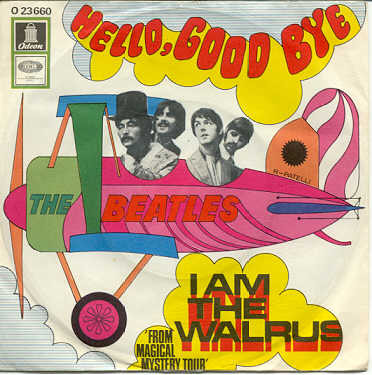
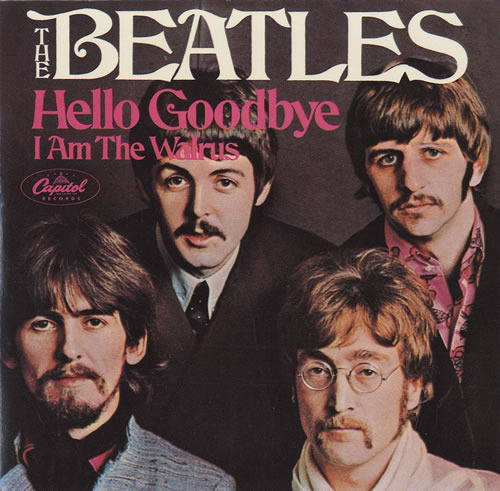
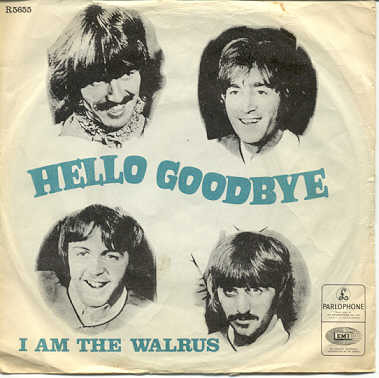
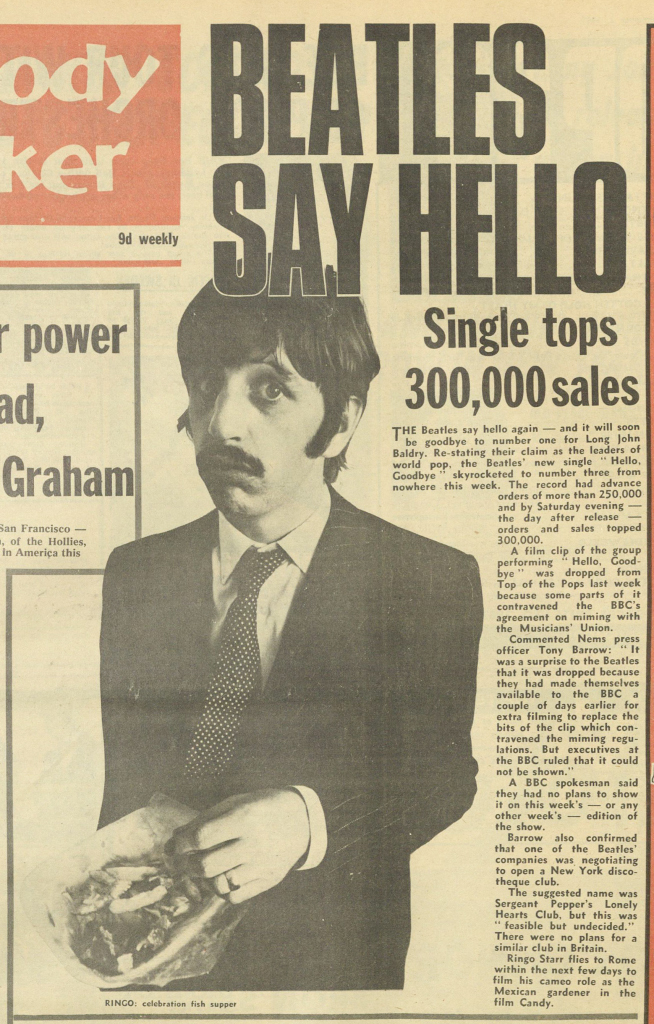
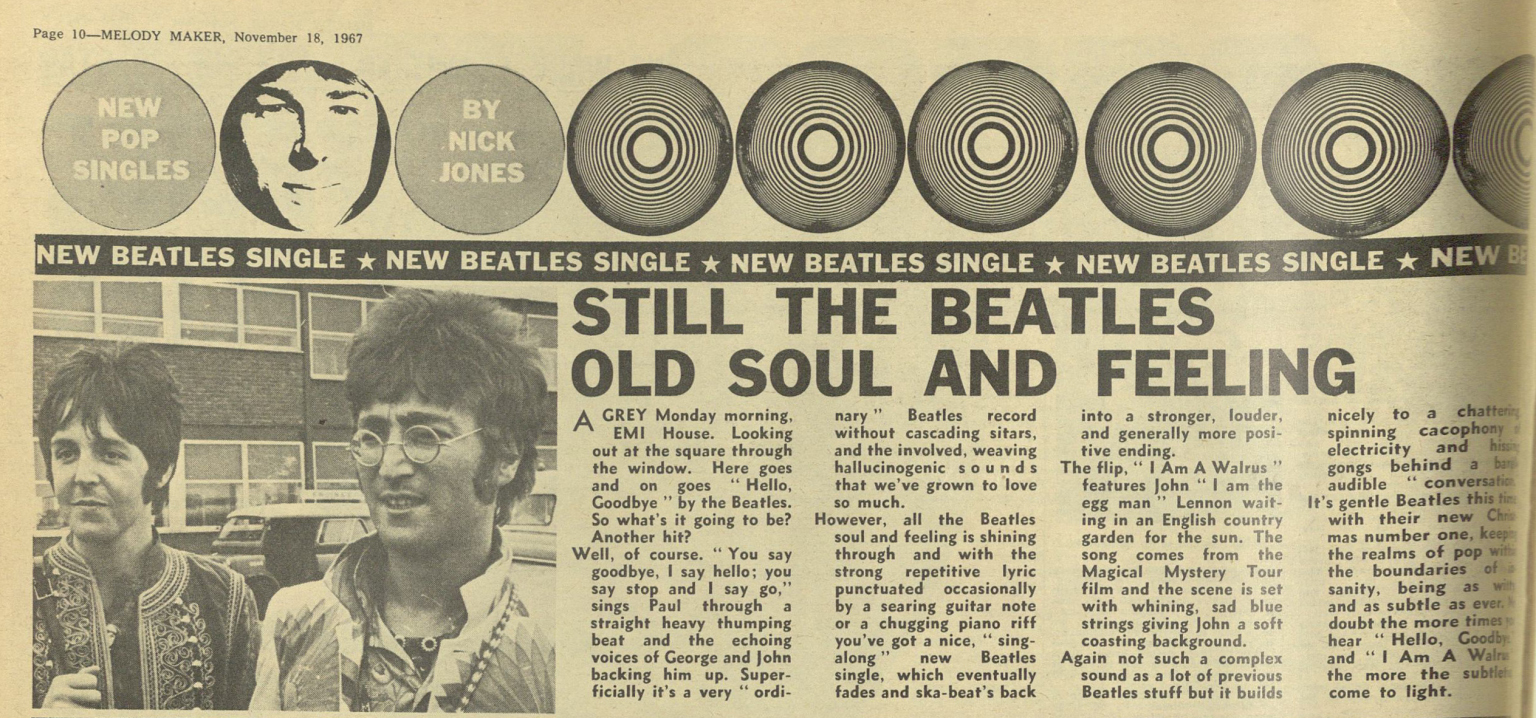
- 1967: The Beatles release the single for "Hello Goodbye" b/w "I Am The Walrus"
Quote:
"Hello, Goodbye" is a song by the English rock band The Beatles. The song was released as a single in November 1967, and topped the charts in the United States, UK and Norway. The song also was a number two hit in both Austria and Switzerland.
Writing
Though the songwriting credit is Lennon/McCartney, it was written solely by Paul McCartney.
Alistair Taylor, who worked for the Beatles' manager, Brian Epstein, had asked McCartney how he wrote his songs, and McCartney took him into his dining room to give him a demonstration on his harmonium. He asked Taylor to shout the opposite of whatever he sang as he played the instrument—black and white, yes and no, stop and go, hello and goodbye. Taylor later said, "I wonder whether Paul really made up that song as he went along or whether it was running through his head already."
Recording
Under the working title "Hello Hello", the Beatles recorded the backing track on 2 October 1967, and added vocals and a guitar overdub on the 19th. After further overdubs of bass guitar and viola, recording was completed on the 2nd November, and mixing on the 6th. "Hello Goodbye" is in the key of C Major and in 4/4 time.
The song features a coda which came spontaneously in the studio. Of this, McCartney said "I remember the end bit where there's the pause and it goes 'Heba, heba hello'. We had those words and we had this whole thing recorded but it didn't sound quite right, and I remember asking Geoff Emerick if we could really whack up the echo on the tom-toms. And we put this echo full up on the tom-toms and it just came alive."
Release
"Hello, Goodbye" was released as a single on 24 November 1967. In the US, the song was also included on the Magical Mystery Tour album released three days later, but the song was not made available in the UK on an album (or in stereo) until the release of the 1973 compilation album 1967–1970.
With the release of the song, McCartney gave an explanation of its meaning in an interview with Disc: "The answer to everything is simple. It's a song about everything and nothing. If you have black you have to have white. That's the amazing thing about life."
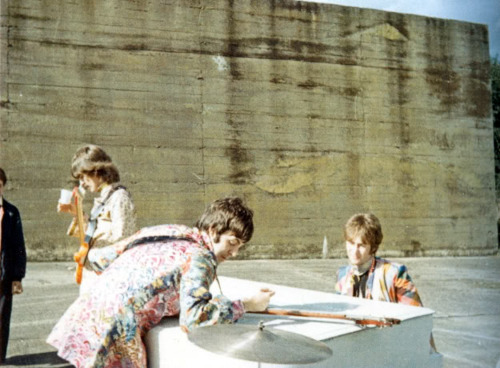
Three promotional films were made for the song; directed by McCartney, they were filmed on the 10th November at the Saville Theatre in London. The films were not aired by the BBC due to the Musicians Union's strict rules on miming; with no such restriction in the US, one of the films was screened on The Ed Sullivan Show on the 26th November.
In the US, Capitol Records omitted the comma in the song’s title in the packaging of the single (as did some of EMI’s partners in other countries), and also the Magical Mystery Tour LP (which was subsequently adopted for the CD release of this album).
Reception
"Hello, Goodbye" topped the charts in both the United States and Britain where it spent seven weeks at number one, and was the Christmas number one for 1967.
Uses
The song’s coda plays over the end titles of the Beatles’ 1967 Magical Mystery Tour film.
B-side "I Am the Walrus"
Released 24 November 1967
Format 7"
Recorded 2 October – 2 November 1967
Abbey Road
Genre Pop rock
Length 3:27
Label Parlophone
Writer(s) Lennon/McCartney
Producer George Martin
Certification Gold (RIAA)
(https://en.wikipedia.org)
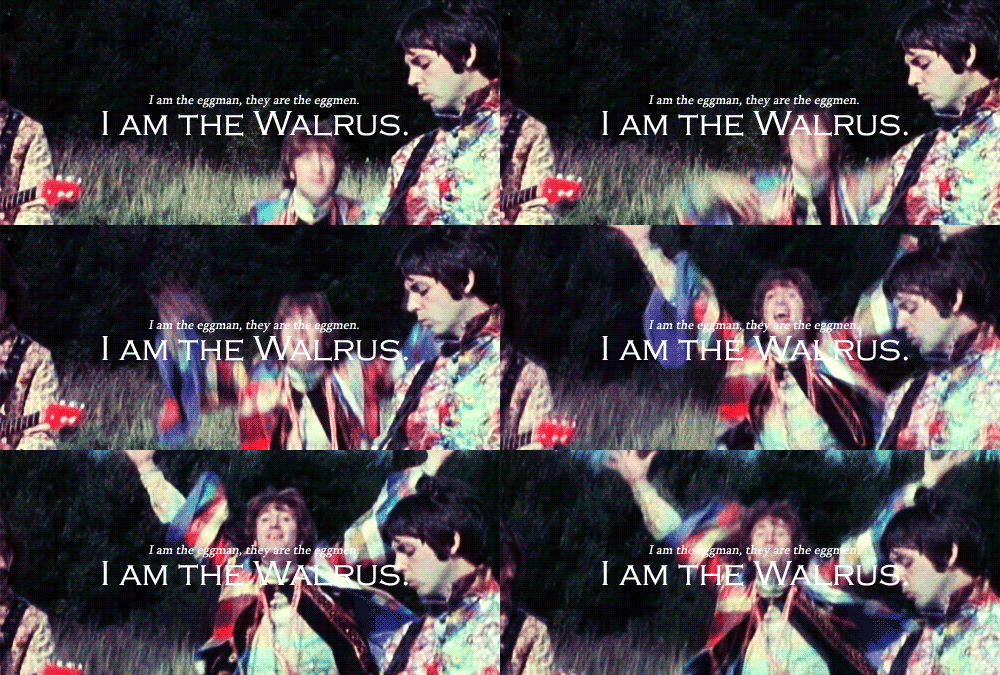
"I Am the Walrus" is a 1967 song by The Beatles, written by John Lennon and credited to Lennon/McCartney.[1] Lennon claimed he wrote the first two lines on separate acid trips. The song was in the Beatles' 1967 television film and album Magical Mystery Tour, and was the B-side to the #1 hit "Hello, Goodbye".
Lennon composed the avant-garde song by combining three songs he had been working on. When he learned that a teacher at his old primary school was having his students analyse Beatles' lyrics, he added a verse of nonsense words.
The walrus is a reference to the walrus in Lewis Carroll's "The Walrus and the Carpenter" (from the book Through the Looking-Glass). Lennon expressed dismay upon belatedly realising that the walrus was a villain in the poem.
Origins
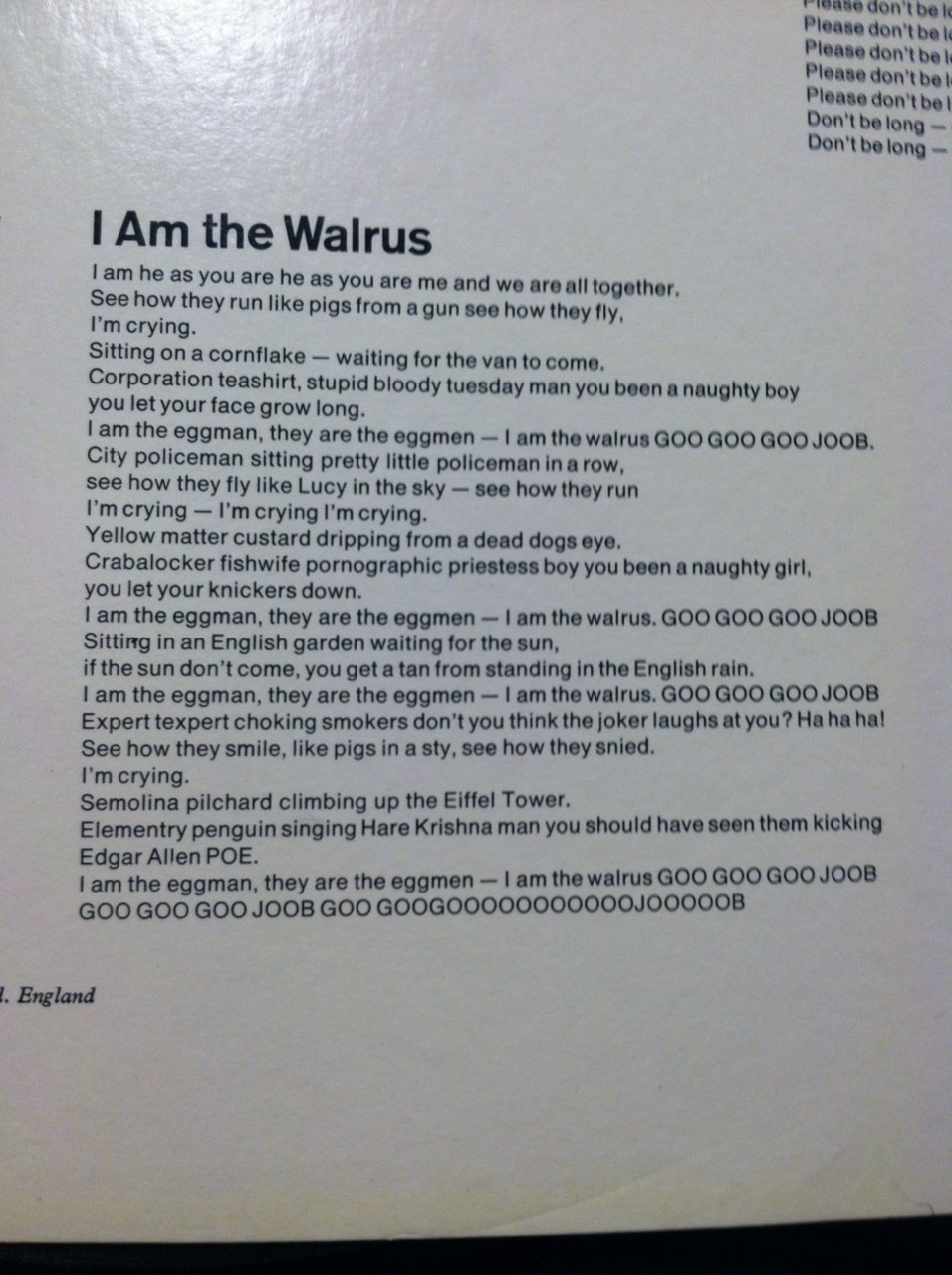
The genesis of the lyrics is found in three song ideas that Lennon was working on, the first of which was inspired by hearing a police siren at his home in Weybridge; Lennon wrote the lines "Mis-ter cit-y police-man" to the rhythm of the siren. The second idea was a short rhyme about Lennon sitting in his garden, while the third was a nonsense lyric about sitting on a corn flake. Unable to finish the ideas as three different songs, he combined them into one.
Lennon received a letter from a pupil at Quarry Bank High School, which he had attended. The writer mentioned that the English master was making his class analyse Beatles' lyrics. (Lennon wrote an answer, dated 1 September 1967, which was auctioned by Christie's of London in 1992). Lennon, amused that a teacher was putting so much effort into understanding the Beatles' lyrics, wrote the most confusing lyrics he could. Lennon's friend and former fellow member of The Quarrymen, Peter Shotton, was visiting, and Lennon asked Shotton about a playground nursery rhyme they sang as children.
Shotton remembered:
"Yellow matter custard, green slop pie,
All mixed together with a dead dog's eye,
Slap it on a butty, ten foot thick,
Then wash it all down with a cup of cold sick".
Lennon borrowed a couple of words, added the three unfinished ideas and the result was "I Am the Walrus". The Beatles' official biographer Hunter Davies was present while the song was being written and wrote an account in his 1968 biography of the Beatles. Lennon remarked to Shotton, "Let the fuckers work that one out." Shotton was also responsible for suggesting to Lennon to change the lyric "waiting for the man to come" to "waiting for the van to come".
All the chords are major chords or seventh chords, and all the musical letters of the alphabet (A, B, C, D, E, F and G) are used. The song ends with a chord progression built on ascending and descending lines in the bass and strings, repeated over and over as the song fades. Musicologist Alan W. Pollack analyses: "The chord progression of the outro itself is a harmonic Moebius strip with scales in bassline and top voice that move in contrary motion." The bassline descends stepwise A, G, F, E, D, C, and B, while the strings' part rises A, B, C, D, E, F#, G: this sequence repeats as the song fades, with the strings rising higher on each iteration. Pollack also notes that the repeated cell is seven bars long, which means that a different chord begins each four-bar phrase.
Lennon explained much of the song to Playboy in 1980:
* "The first line was written on one acid trip one weekend. The second line was written on the next acid trip the next weekend, and it was filled in after I met Yoko... I'd seen Allen Ginsberg and some other people who liked Dylan and Jesus going on about Hare Krishna. It was Ginsburg, in particular, I was referring to. The words "Element'ry penguin" meant that it's naïve to just go around chanting Hare Krishna or putting all your faith in one idol. In those days I was writing obscurely, a la Dylan."
* "It never dawned on me that Lewis Carroll was commenting on the capitalist system. I never went into that bit about what he really meant, like people are doing with the Beatles' work. Later, I went back and looked at it and realized that the walrus was the bad guy in the story and the carpenter was the good guy. I thought, Oh, shit, I picked the wrong guy. I should have said, 'I am the carpenter.' But that wouldn't have been the same, would it? [Sings, laughing] 'I am the carpenter....'"
Recording
"I Am the Walrus" was the first studio recording made after the death of the Beatles' manager Brian Epstein in August 1967. The basic backing track featuring the Beatles was released in 1996 on Anthology 2. George Martin arranged and added orchestral accompaniment that included violins, cellos, horns, clarinet and a 16-piece choir. Paul McCartney said that Lennon gave instructions to Martin as to how he wished the orchestration to be scored, including singing most of the parts as a guide. A large group of professional studio vocalists named "The Mike Sammes Singers", took part in the recording as well, variously singing "Ho-ho-ho, hee-hee-hee, ha-ha-ha", "oompah, oompah, stick it up your jumper!", "everybody's got one" and making a series of shrill whooping noises.The song also features another Beatles song with an unrelated coda in the shape of new parts of strings, new choruses and the sampling of a radio in its fade-out.
The dramatic reading in the mix towards the end of the song is a few lines of Shakespeare's King Lear (Act IV, Scene VI), which were added to the song direct from an AM radio receiving the broadcast of the play on the BBC Home Service (or possibly the BBC Third Programme). Lennon said in a 29 September 1974 radio interview with disc jockey Dennis Elsas that he "didn't even know it was Lear" until someone brought it up to him much later. The bulk of the audible dialogue, heard in the fade, is the death scene of the character Oswald (including the words, "O untimely Death! Death!"); this is a piece of the "Paul is dead" urban legend. Two other lines from the play are at the beginning of the third chorus, 2:25 into the song. They are taken from the two lines:
"Glou. Now, good sir, what are you?
Edg. A most poor man, made tame to fortune's blows, Who, by the art of known and feeling sorrows, Am pregnant to good pity."
These lines are faded in and out in the recording, so that we hear only: "Now, good sir;" "man, made tame to fortune's;" and "good pity."
Different versions
In the original (1967) stereo release, at around two minutes through the song, the mix changes from true stereo to "fake stereo". This came about because the radio broadcast had been added 'live', off-air, into the mono mix-down and so was unavailable for inclusion in the stereo mix; hence, fake stereo from the mono mix was created for this portion of the song.
The mono version opens with a four-beat chord while the stereo mix features six beats on the initial chord. The four-beat-only-intro is also included on a different stereo mix (overseen by George Martin) for the most recent home video version of Magical Mystery Tour. The US mono single mix includes an extra bar of music before the words "yellow matter custard"; an early, overdub-free mix of the song released on The Beatles Anthology 2 reveals John singing the lyrics "Yellow mat -" too early—this was edited out. A hybrid version prepared for the 1980 US Rarities LP combines the six-beat opening with the extra bar of music that precedes the words "yellow matter custard" (from the aforementioned US mono single mix).
In 2003, the first-ever completely true stereo mix of the song (albeit with the introduction covered by narration voice-over), including the formerly "fake stereo" second half, was included on The Beatles Anthology release to DVD (a change from the VHS edition); and in 2006, the first-ever stereo mix of the complete song (albeit in "mash-up" form: i.e. - not a "straight" remix) was issued on the Beatles' album Love. The true stereo mix had been made possible when a separate recording of the same King Lear radio performance used in the original mix was located.
Personnel
* John Lennon – lead vocals, electric piano, mellotron
* Paul McCartney – bass, tambourine, backing vocals
* George Harrison – electric guitar, backing vocals
* Ringo Starr – drums
* Orchestrated, directed and produced by George Martin.
* Session musicians: strings, brass and woodwinds.
* Mike Sammes singers – background vocals.
* Engineered by Geoff Emerick and Ken Scott.
* Mixed by Geoff Emerick and John Lennon.
Reception
Critical reception at the time of the track's release was positive:
* "John growls the nonsense (and sometimes suggestive) lyric, backed by a complex scoring incorporating violins and cellos. You need to hear it a few times before you can absorb it." - Derek Johnson
* "Into the world of Alice in Wonderland now and you can almost visualise John crouching on a deserted shore singing "I am the Walrus" to some beautiful strings from far away on the horizon and a whole bagful of Beatle sounds, like a ringing doorbell and someone sawing a plank of wood. A fantastic track which you will need to live with for a while to fully appreciate." - Nick Logan
Interpretation
Although it has been reported that Lennon wrote I am the Walrus to confuse those who tried to interpret his songs, there have been many attempts to analyse the meaning of the lyrics.
Who was the Walrus?
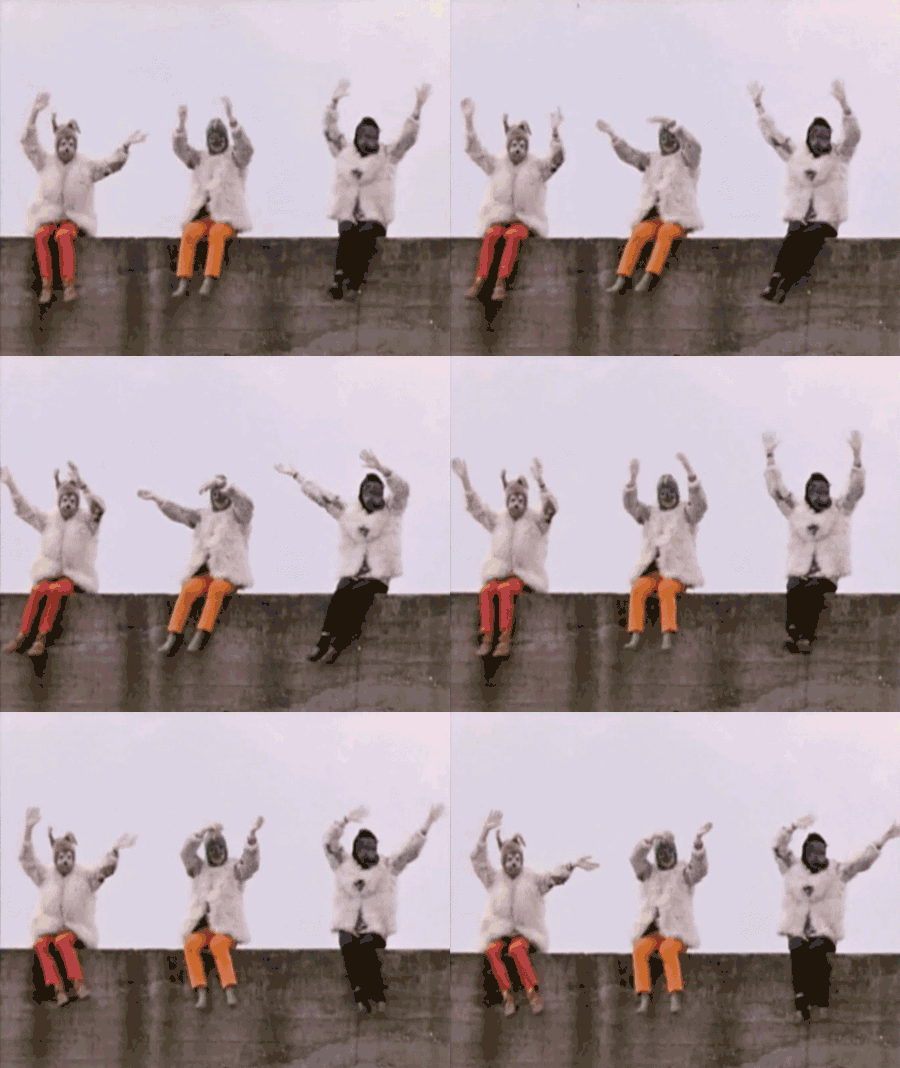
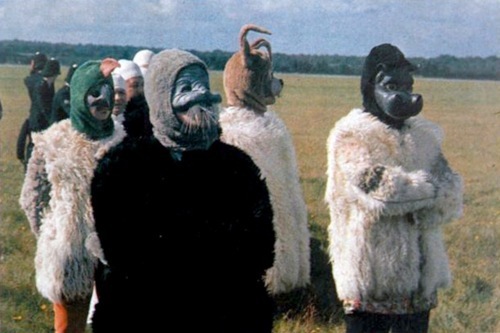
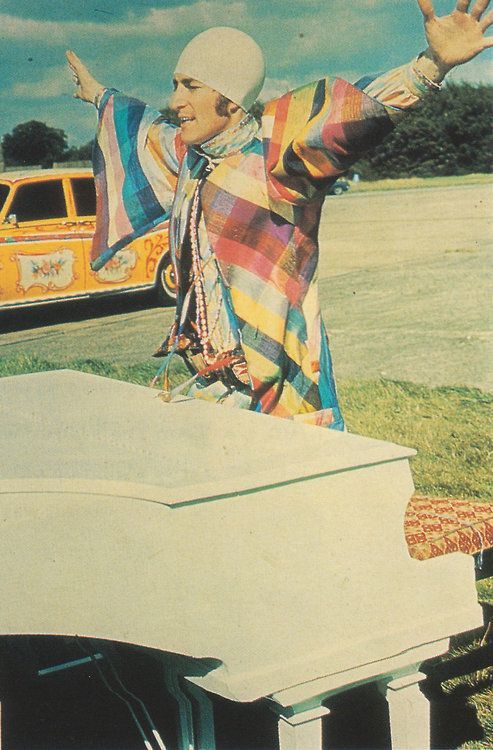
Ostensibly Lennon is the walrus as he appears in the Magical Mystery Tour film singing the song. On the track-list of the accompanying soundtrack EP/LP, underneath "I Am the Walrus" are printed the words ' "No you're not!" said Little Nicola' (in the film, Nicola is a little girl who keeps contradicting everything the other characters say). Lennon returned to the subject in the lyrics of two of his subsequent songs: in the 1968 Beatles song "Glass Onion" he sings "now here's another clue for you all — the walrus was Paul", and in his 1970 solo song "God", "I was the walrus, but now I'm John."
Who was the Eggman?
Eric Burdon, lead singer of The Animals, is claimed by some to be the 'Eggman'. Burdon was known as 'Eggs' to his friends, the nickname originating from his fondness for breaking eggs over naked women's bodies. Burdon's biography mentions such an affair taking place in the presence of John Lennon, who shouted "Go on, go get it, Eggman..."
A-side "Hello, Goodbye"
Released 24 November 1967
Format 7"
Recorded 5 September 1967,
EMI Studios, London
Genre Psychedelic rock
Length 4:34
Label Parlophone
Writer(s) Lennon/McCartney
Producer George Martin
(https://en.wikipedia.org)

--------------------
--------------------------------
Mp3 of the month: Wild Things- Another Colored Ink Drawing (A.C.I.D.)

Edited by Learyfan (11/22/20 09:03 AM)
|

 Threaded
 Previous
 Index
Index Next
Next Bulk Cannabis Seeds
  Unfolding Nature: Being in the Implicate Order
  North Spore Mushroom Grow Kits & Cultivation Supplies
  Golden Teacher Liquid Culture For Sale
  Spores for European Microscopy
 Some of these posts are very old and might contain outdated information. You may wish to search for newer posts instead.
 Learyfan


 Edit
Edit  Reply
Reply 






 Sorry to make you feel old, NB. How was your trip though?





 1 2 all )
 Learyfan
 sancho
 Rose
Rose

 chronny
 Zoso_UK