Home | Community | Message Board


This site includes paid links. Please support our sponsors.


Welcome to the Shroomery Message Board! You are experiencing a small sample of what the site has to offer. Please login or register to post messages and view our exclusive members-only content. You'll gain access to additional forums, file attachments, board customizations, encrypted private messages, and much more!

Shop: MagicBag.co All-In-One Bags That Don't Suck   North Spore North Spore Mushroom Grow Kits & Cultivation Supplies   Mushroom-Hut Liquid Cultures   Sporeworks.EU Spores for European Microscopy

Jump to first unread post Pages: 1
Some of these posts are very old and might contain outdated information. You may wish to search for newer posts instead.
Bolete ID
    #4372187 -

These bolete were found in NE Wisconsin. Our property has a vast variety of bolete and I would love to know what they are and if they are edible. Thanks for any help!


Found under pine and popple. Dark tan/brown cap. Firm stem with netting design. White pores. Does not turn color when cut.


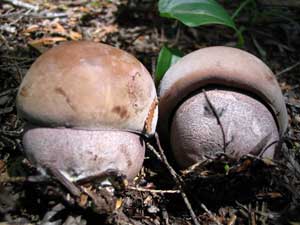
Found in a hemlock woods. Very fresh, and pale lavender. Too young to see pores. Did not change color when cut.


Found in hemlock woods. Growing single or in pairs. Some were very fresh others older and dry. Pale red fading to bright yellow. Stem firm and solid yellow, pores yellow. Did not turn any color when cut.


Found in jack pines and popple woods. Light brown cap with white pores and black flecks on stem. Pores white. Turned black when cut and then turned to mush overnight.


Found in jack pines and popple woods. Tan firm cap, Yellow pores, stem with a netting design. Stem very fibrous but not hollow. Did not turn color when cut.

Extras: Filter Print Post Top
Re: Bolete ID [Re: pegasus]
    #4372900 -

Hi pegasus,

ToxicMan is the Bolete expert, but I will tell you what I know about them. Boletes are the safest kind of mushroom to eat, because unlike the gilled mushrooms, there is a simple set of rules for testing edibility.


All boletes can be eaten with the following exceptions.

1) Red and yellow boletes. These should not be eaten because there are lots of poisonous species with this coloration. Either color by itself or in combination with other colors is OK, but Boletes with both red and yellow together should not be eaten.

2)Boletes which bruise blue. While there are some edible blue bruising boletes, there are more poisonous species with this characteristic. Blue bruising boletes should not be eaten unless they are identified as a safe species by an expert mycologist. 

3)Any other bolete which is too bitter to be palatable. This can be a fun field test which is safe with boletes. Just chew up a small piece and spit it out. If it's bitter you will know it. When I go hunting with friends I like to pick boletes which I know are bitter and have my friends field test them. Hehehe  :evil:
It won't hurt you to eat these, but one bitter bolete can ruin the sauce.

Judging from these criteria:

#1 Is edible. Test to see if it's bitter.

#2 Those lavender ones are beautiful, but in my experience they always turn out bitter.

#3 Yellow and red. Pitch em.

#4 Something tells me that those would not be good to eat, but that's just a guess. They key out safe using the above method.

#5 Keys out safe. Check for flavor before cooking.

I hope that helps.

Extras: Filter Print Post Top
Re: Bolete ID [Re: pegasus]
    #4373934 -

On each of your specimens, try scratching the pore surface (a fingernail works well) and seeing if it changes color. Note that a change of color is not the same as an intensification of color. If it changes color, note roughly how long it took for the change to happen.

Does the reticulation (the fancy name for the net-like pattern on the stem) go down more than halfway or just one third or less?

On the second ones, go ahead and carve out the stem from one to get to the pores. It might be easiest if you cut it in half vertically first. Also, what does the surface of the stem look like?

On any of them where you didn't describe it, we need to know what the surface of the stem looks like. Is there a netlike pattern (reticulation - it can be difficult to see on some species), or are there scabers, or are there glandular dots), or is it just smooth? If you're unsure of those terms, look them up here.


BTW, shroomydan, it's red or orange tubes or tube mouths that are one of the indicators for poisonous species. The cap color isn't important for making that distinction, that I'm aware of.

Happy mushrooming!


--------------------
Happy mushrooming!

Extras: Filter Print Post Top
Jump to top Pages: 1

Shop: MagicBag.co All-In-One Bags That Don't Suck   North Spore North Spore Mushroom Grow Kits & Cultivation Supplies   Mushroom-Hut Liquid Cultures   Sporeworks.EU Spores for European Microscopy


Similar ThreadsPosterViewsRepliesLast post
* Help with Bolete ID Earth Shaman 1,590 3 07/28/03 11:58 PM
by ToxicMan
* bolete id anyone? wallace 1,106 5 08/26/04 05:55 PM
by wallace
* Bolete ID help? TomJoad 1,123 2 08/13/05 09:07 PM
by 3six5
* Bolete ID ChiefThunderbong 796 2 11/11/03 10:50 AM
by ToxicMan
* Bolete I.D. Chiefess 866 2 07/18/05 09:16 PM
by ToxicMan
* Bolete? ID please zeta 1,164 4 12/02/02 03:17 AM
by zeronio
* Need a Bolete ID please ArmFromTheAbyss 1,234 6 08/21/03 06:26 PM
by The_Red_Crayon
* Boletaceae hunting in NJ/PA w/ pictures (ID would be useful) nicuss 3,201 9 10/22/02 07:27 AM
by Unity333

Extra information
You cannot start new topics / You cannot reply to topics
HTML is disabled / BBCode is enabled
Moderator: ToxicMan, karode13, inski, Alan Rockefeller, Duggstar, TimmiT, Anglerfish, Tmethyl, Lucis, Doc9151, Land Trout
7,303 topic views. 0 members, 152 guests and 71 web crawlers are browsing this forum.
[ Show Images Only | Sort by Score | Print Topic ]
Search this thread:

Copyright 1997-2026 Mind Media. Some rights reserved.

Generated in 0.028 seconds spending 0.009 seconds on 16 queries.