- 1943: H. Rap Brown is born
Quote:
Jamil Abdullah Al-Amin (born Hubert Gerold Brown; October 4, 1943), also known as H. Rap Brown, was the fifth chairman of the Student Nonviolent Coordinating Committee in the 1960s, and during a short-lived (six months) alliance between SNCC and the Black Panther Party, he served as their minister of justice.
He is perhaps most famous for his proclamations during that period that "violence is as American as cherry pie" and that "If America don't come around, we're gonna burn it down." He is also known for his autobiography, Die Nigger Die! He is currently serving a life sentence for murder following the 2000 shooting of two Fulton County Sheriff's deputies.
Activism
He later organized for SNCC during Mississippi Freedom Summer, while transferring his studies to Howard University. Representing Howard's SNCC chapter, Brown attended a contentious civil rights meeting at the White House with President Lyndon Johnson during the Selma crisis of 1965. In 1966, he organized for black voter registration and enforcement of the recently passed Voting Rights Act in Greene County, Alabama. Elected SNCC chairman in 1967, Brown continued Stokely Carmichael's fiery support for "Black Power" and urban rebellions in the ghettos.
In the late 1960s, Brown was tried on federal charges of inciting to riot and carrying a gun across state lines. A secret 1967 FBI memo called for "neutralizing" Brown and he was targeted by the COINTELPRO program at this time. The charges were never proven. His attorneys in the gun violation case were civil rights advocate Murphy Bell of Baton Rouge, the self described "radical lawyer" William Kunstler, and Howard Moore, Jr., general counsel for SNCC. Feminist attorney Flo Kennedy also assisted Brown and led his defense committee, winning him support from some chapters of the National Organization for Women.
(https://en.wikipedia.org)
Quote:
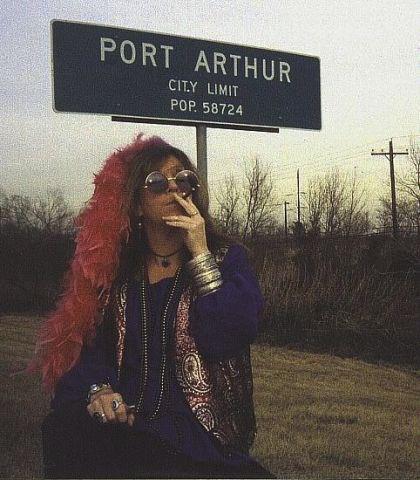
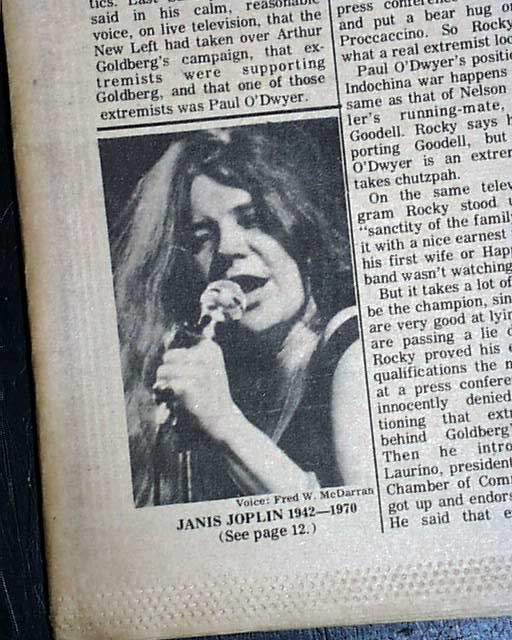
Janis Lyn Joplin (January 19, 1943 – October 4, 1970) was an American singer, songwriter, painter, dancer and music arranger. She rose to prominence in the late 1960s as the lead singer of Big Brother and the Holding Company and later as a solo artist with her backing groups, The Kozmic Blues Band and The Full Tilt Boogie Band. At the height of her career she was known as The Queen of Rock and Roll as well as The Queen of Psychedelic Soul. Rolling Stone magazine ranked Joplin number 46 on its list of the 100 Greatest Artists of All Time in 2004, and number 28 on its 2008 list of 100 Greatest Singers of All Time.
Death
The last recordings Joplin completed were on October 1, 1970 — Mercedes Benz and a birthday greeting for John Lennon, the Dale Evans Happy Trails. Lennon, whose birthday was October 9, later told Dick Cavett that her taped greeting arrived at his home after her death. On Saturday, October 3, Joplin visited Sunset Sound Recorders in Los Angeles to listen to the instrumental track for Nick Gravenites' song Buried Alive in the Blues prior to recording the vocal track, scheduled for the next day. At some point on Saturday, she learned by telephone that Seth Morgan was staying at her home and using her pool table with other women he had met that day. In the studio she was heard expressing anger about this and about Morgan having broken a promise to visit her the previous night, although she also expressed joy about the progress of the sessions. She and band member Ken Pearson went from the studio to Barney's Beanery[ for drinks. After midnight, Joplin drove him and a male fan who tagged along to the Landmark Motor Hotel.
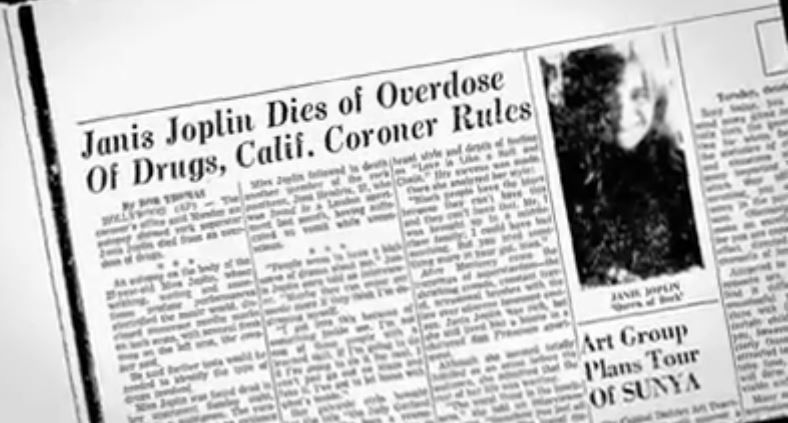
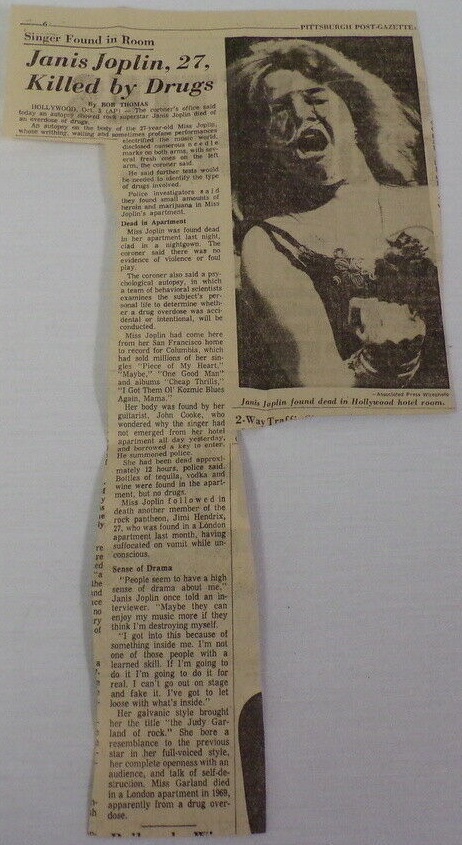
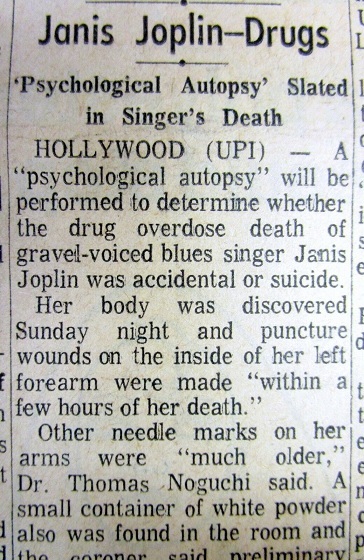
When Joplin failed to show up at Sunset Sound Recorders for the next recording session by Sunday afternoon, producer Paul A. Rothchild became concerned. Full Tilt Boogie's road manager, John Cooke, drove to the Landmark. He saw Joplin's psychedelically painted Porsche 356C Cabriolet in the parking lot. Upon entering her room, he found her dead on the floor beside her bed. The official cause of death was an overdose of heroin, possibly combined with the effects of alcohol. Cooke believes that Joplin had accidentally been given heroin which was much more potent than normal, as several of her dealer's other customers also overdosed that week. Peggy Caserta admitted that, like Seth Morgan, she, too, had promised to visit Joplin at the Landmark on Friday night, October 2 and had stood her up in order to party with drug users who were staying at another Los Angeles hotel. According to Going Down With Janis, Caserta learned from the dealer who sold heroin to her and Joplin that on Saturday Joplin expressed sadness about two friends having abandoned her the previous night.
Joplin was cremated in the Pierce Brothers Westwood Village Mortuary in Los Angeles; her ashes were scattered from a plane into the Pacific Ocean and along Stinson Beach. The only funeral service was a private affair held at Pierce Brothers and attended by Joplin's parents and maternal aunt.
Joplin's will funded $2,500 to throw a wake party in the event of her demise. Around 200 guests received invitations to the party that read, “Drinks are on Pearl,” a reference to Joplin’s nickname. The party, which took place October 26, 1970, at the Lion's Share, located in San Anselmo, California, was attended by Joplin's sister Laura, fiancé, Seth Morgan and close friends, including tattoo artist Lyle Tuttle, Bob Gordon, and road manager John Cooke. Hash brownies were passed around.
Legacy
Joplin's death in October 1970 at the age of 27 stunned her fans and shocked the music world. Her death was coupled with the fact that another rock icon, Jimi Hendrix, had died sixteen days earlier in September. Music historian Tom Moon wrote that Joplin had "a devastatingly original voice." Music columnist Jon Pareles of the New York Times wrote that Joplin as an artist was "overpowering and deeply vulnerable." Author Megan Terry claimed that Joplin was the female version of Elvis Presley in the ability to captivate an audience.
In 1973, a book about Joplin by her publicist Myra Friedman was excerpted in many newspapers. At the same time, Going Down With Janis by Peggy Caserta attracted a lot of attention with its opening line, which graphically referred to her performing a sex act with Joplin while they were stoned on heroin in September 1970. Joplin's bandmate Sam Andrew much later described Caserta as "halfway between a groupie and a friend." According to an early 1990s statement by a close friend of Caserta who also knew Joplin, Caserta's book Going Down With Janis angered the Los Angeles heroin dealer she described in detail to her readers, including the make and model of his car. A "carful of dope dealers," wrote Ellis Amburn, visited, in 1973, a Los Angeles lesbian bar that Caserta had been frequenting since Joplin was alive. Amburn quoted Caserta's friend Kim Chappell, who happened to be in the alley behind the bar: "I was stabbed because, when Peggy's book came out, her dealer, the same one who'd given Janis her last fix, didn't like it that he was referred to and was out to get Peggy. He couldn't find her, so he went for her lover. When they realized who I was, they felt that my death would also hit Peggy, and so they stabbed me." Despite being "stabbed three times in the chest, puncturing both lungs," Chappell eventually recovered.
According to biographers Alice Echols and Myra Friedman, Peggy Caserta was one of many friends of Joplin who did not become clean and sober until a very long time after the singer's death, and others died from overdoses. One of her Big Brother bandmates got clean and sober as late as 1984. Caserta survived "a near-fatal OD in December 1995," wrote Echols. In 2000, Caserta appeared on-camera as a major source for a segment about Joplin on 20/20 (US television series).
Joplin's extraordinary success as a pioneer in a male-dominated rock industry of the late 1960s was unprecedented.[citation needed] Joplin, along with Grace Slick of the Jefferson Airplane, opened opportunities into the rock music business for future female singers. Stevie Nicks commented that after seeing Joplin perform, "I knew that a little bit of my destiny had changed. I would search to find that connection that I had seen between Janis and her audience. In a blink of an eye she changed my life."
Joplin's body art, with a wristlet and a small heart on her left breast, by the San Francisco tattoo artist Lyle Tuttle, is taken as a seminal moment in the tattoo revolution and was an early moment in the popular culture's acceptance of tattoos as art. Another trademark was her flamboyant hair styles, often including colored streaks and accessories such as scarves, beads and feathers. When in New York City, Joplin, often in the company of actor Michael Pollard, frequented Limbo on St. Marks Place. The performer, well known to the store's employees, made a practice of putting aside vintage and other one-of-a-kind garments she favored on stage and off.
Leonard Cohen's 1974 song "Chelsea Hotel #2" is about Joplin. Likewise, lyricist Robert Hunter has commented that Jerry Garcia's "Birdsong" from his first solo album, Garcia, is about Joplin and the end of her suffering through death. Mimi Farina's composition "In the Quiet Morning", most famously covered by Joan Baez on her 1972 Come from the Shadows album, was a tribute to Joplin.
The 1979 film The Rose was loosely based on Joplin's life. Originally titled Pearl, after Joplin's nickname, and the title of her last album, it was fictionalized after her family declined to allow the producers the rights to her story. Bette Midler earned a nomination for the Academy Award for Best Actress for her performance.
In 1988, the Janis Joplin Memorial, with an original bronze, multi-image sculpture of Joplin by Douglas Clark, was dedicated in Port Arthur, Texas.
Joplin was inducted into the Rock and Roll Hall of Fame in 1995, and was given a Grammy Lifetime Achievement Award in 2005. In November 2009, the Hall of Fame and museum honored her as part of its annual American Music Masters Series. Among the artifacts at the Rock and Roll Hall of Fame Museum Exhibition are Joplin's scarf and necklaces, her 1965 Porsche 356 Cabriolet with psychedelically designed painting, and a sheet of LSD blotting paper designed by Robert Crumb, designer of the Cheap Thrills cover. She was the honoree at the Rock Hall's American Music Master concert and lecture series for 2009.
In the late 1990s, the musical play Love, Janis was created with input from Janis's younger sister Laura plus Big Brother guitarist Sam Andrew, with an aim to take it to Off Broadway. Opening in the summer of 2001 and scheduled for only a few weeks of performances, the show won acclaim and packed houses and was held over several times, the demanding role of the singing Janis attracting rock vocalists from relative unknowns to pop stars Laura Branigan and Beth Hart. A national tour followed.
There have been many attempts at making a film about Joplin. On June 13, 2010, producer Wyck Godfrey said Amy Adams starred in director Fernando Meirelles' biographical drama, titled Janis Joplin: Get It While You Can. Previous attempts have included Piece Of My Heart, which was to star Renée Zellweger or Brittany Murphy; The Gospel According To Janis, with director Penelope Spheeris and starring either Zooey Deschanel or P!nk; and an untitled film thought to be an adaptation of Laura Joplin's Off-Broadway play about her sister, with the show's star, Laura Theodore, attached.
Joplin had a profound influence on many singers. Florence Welch of Florence and The Machine spoke of Joplins impact on her own musical prowess in an interview for Why Music Matters in a commercial against piracy:
I learnt about Janis from an anthology of female blues singers. Janis was a fascinating character who bridged the gap between psychedelic blues and soul scenes. She was so vulnerable, self-concious and full of suffering. She tore herself apart yet on stage she was totally different. She was so unrestrained, so free, so raw and she wasn't afraid to wail.Her connection with the audience was really important. It seems to me the suffering and intensity of her performance go hand in hand. There was always a sense of longing, of searching for something. I think she really sums up the idea that soul is about putting your pain into something beautiful.
(https://en.wikipedia.org)

--------------------
--------------------------------
Mp3 of the month: Wild Things- Another Colored Ink Drawing (A.C.I.D.)

Edited by Learyfan (10/04/23 10:18 AM)
|

 Threaded
 Previous
 Index
 Next
 Isolated Cubensis Liquid Culture For Sale
 Unfolding Nature: Being in the Implicate Order
 Feminized Cannabis Seeds
 Learyfan


 Computerism




 Edit
 Reply






 DeadPhan

 PrisonSong
 1 2 all )
 Nuggetpouch

 Revelation
 freddurgan

 Psy Baba
 MOTH
 sui