Auto-SummaryMichael Bowen, born December 8, 1937, was an American fine artist and co-founder of the Visionary art movement, known for his involvement in the American Beat Generation and the 1960s counterculture. He moved to San Francisco in the late 50s, becoming an integral part of the San Francisco Renaissance. Bowen's work is featured in the Wennesland Foundation Collection in Norway and he inspired the first Human Be-In in San Francisco, which became a symbol of the hippie counterculture. Bowen's influence extended to New York City, where he met with Beat Generation artists and intellectuals, and later organized the Love Pageant Rally and the Human Be-In, which became iconic events during the summer of love.
- 1937: Michael Bowen is born
Quote:
Michael Bowen (December 8, 1937 – March 7, 2009) was an American fine artist known as one of the co-founders of the late 20th and 21st century Visionary art movements. His works include paintings on canvas and paper, 92 intaglio etchings based on Jungian psychology, assemblage, bronze sculpture, collage, and handmade art books.
An icon of the American Beat Generation and the 1960s counterculture, Bowen is also known for his role in inspiring and organizing the first Human Be-In in San Francisco. Chronicled in books and periodicals reflecting on the turbulent 60s, Bowen's historical impact on both the literary and visual art worlds is well documented. He remains influential among avante-garde art circles around the world.
San Francisco Beat Generation
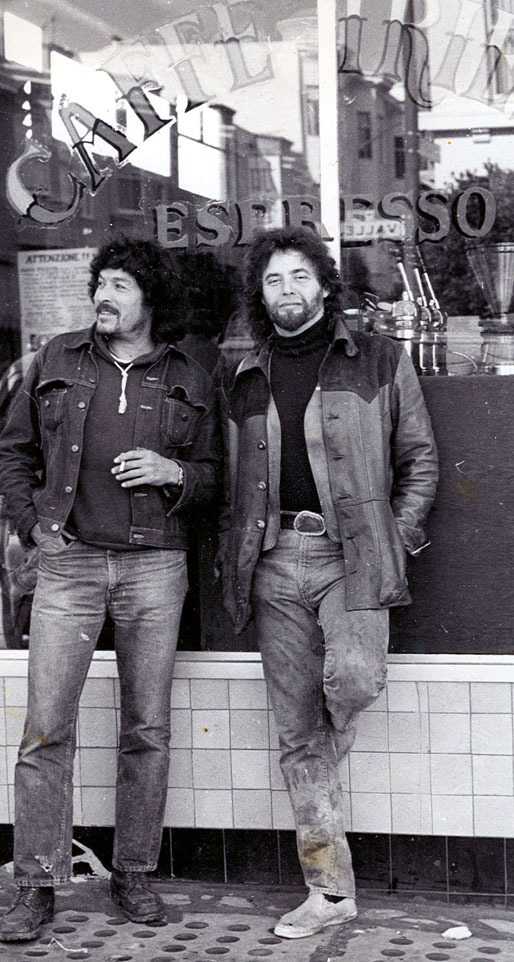
Michael Bowen moved to San Francisco in the late 50s, and along with fellow artist comrades Arthur Monroe and Michael McCracken, lived and worked out of 72 Commercial Street. Painting spontaneous, impromptu, hectic canvases, along with assemblage and collage, Bowen became an integral part of the San Francisco Renaissance.
The Norwegian art patron and physician Reidar Wennesland befriended Bowen and many of his bohemian artist friends and collected their artwork. Bowen's work now makes up the majority of the paintings in the Wennesland Foundation Collection located in Kristiansand, Norway, alongside many other important North Beach artists, such as Jay DeFeo. A 1963 painting of Janis Joplin by Bowen, along with his prophetic 1966 Love painting, are examples of the Bowen works in the Wennesland collection. Bowen's style progressed from large abstract expressionist canvases to figuratives and large faces, to assemblage. Bowen's painting about McCarthyism, Red Future? from the Wennesland Collection, was featured in the 1995 Whitney Museum exhibition Beat Culture and the New America, 1950-1965, which opened in New York City and then traveled to the Walker Art Center in Minneapolis and the De Young Museum in San Francisco.
Exile from San Francisco
In 1963, police brutality and persecution drove many of the Beat Generation writers, musicians, and artists out of San Francisco. Michael Bowen, along with many of his artist friends moved to an old Abalone Factory in Princeton by the Sea, where they lived and painted for many months. Bowen's singer friend, Janis Joplin was a frequent guest at the Princeton Abalone studio.
In 1963, on one of Bowen's visits to be with his mentor in Tepoztlan, he was initiated into an ancient Aztec shamanic ceremony that inspired his future work with world consciousness transformation. After his initiation, Bowen traveled to New York City, where he established a studio in the Lower East Side and met with many of the Beat Generation artists, writers, and musicians living on America's East Coast. He often visited the two former Harvard professors Timothy Leary and Ram Dass, then Richard Alpert, in their mansion at Millbrook, New York, where a new variety of consciousness experimentations were being conducted.
Haight-Ashbury and the Summer of Love
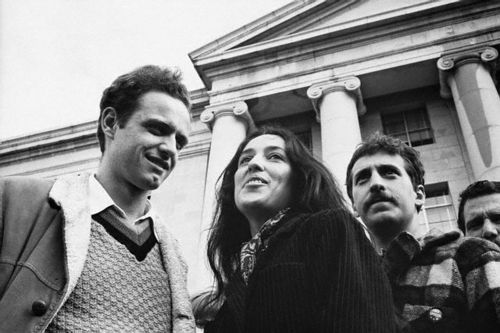
In the summer of 1966, Michael Bowen traveled back to San Francisco and established a studio/ashram in the middle of the newly burgeoning Haight-Ashbury neighborhood. Along with the poet Allen Cohen, Bowen co-founded the underground newspaper, San Francisco Oracle that broadcast the 60s counterculture ideology. Bowen became the art director and let his studio become the offices for the Oracle, while Cohen was the editor. As the S.F. Oracle guru, Bowen hosted the first underground press meeting at his studio at Stinson Beach.
On October 6, 1966, Bowen and Cohen organized the Love Pageant Rally, a celebration against the new law criminalizing LSD in California. Because of Bowen's friendship and invitation, Janis Joplin came to the event along with her band, Big Brother and the Holding Company, and played for free. About 3,000 people attended the Love Pageant Rally, and towards the end, Ram Dass, Cohen, and Bowen discussed having another event, this time much bigger, to celebrate the newly developing hippie counterculture and consciousness expansion in San Francisco.
The Human Be-In
The event the three counterculture leaders previously envisioned became the Human Be-In, which took place on January 14, 1967. The event was primarily organized by Bowen. He created the poster promoting the event, organized the city permit, invited the Beat Generation speakers, including Allen Ginsberg, Gary Snyder, Lenore Kandel, Michael McClure, and Timothy Leary, and scheduled the San Francisco rock bands, including The Grateful Dead and Jefferson Airplane, who played for free at the event. The Hells Angels provided security, and a flatbed truck with amplification driven by a gas generator was donated to create a stage. The Human Be-In was a coming together of people for no other reason than to just "BE"; to make love, not war, to share and commune with new friends and to celebrate life. The Human Be-In, sometimes referred to as a Love-In, was specifically designed by Bowen to be imitated and to be remembered into the future. As a lifelong fine artist, Bowen considers his creation of the Human Be-In to be performance art. This notion was confirmed by an Italian journalist, who calls Bowen "The father of performance art" for his Human Be-In creation.
Flower Power
On October 21, 1967, 75,000 anti-war protesters surrounded the Pentagon in Washington D.C.. On that day, Bowen organized 200 lbs. of daisies, purchased by his New York friend Peggy Hitchcock, (the wife of Walter Bowart), to be dropped from a light aircraft onto the Pentagon, but the FBI heard of the plan and seized the aircraft, so the flowers were distributed to the protesters as the Military Police protected the Pentagon from the massive anti Vietnam War demonstration. The daisies, brought to the front lines of the tense confrontation by Bowen and others, were taken by the demonstrators and put into the nearest holder that symbolically communicated their anti-war sentiment. The iconic photograph "Flower Power", taken by photojournalist Bernie Boston, of the daisies being put into the bayoneted gun barrels of the soldiers by the unarmed anti-war demonstrators, was nominated for a Pulitzer Prize in 1968. The photograph "flower power" is listed as #30 amongst the top 100 wartime photographs and the idealism of flower power remains as an anti-war symbol.
(https://en.wikipedia.org)
- 1942: Mario Savio is born
Quote:
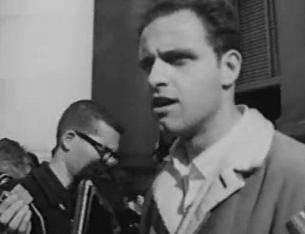
Mario Savio (December 8, 1942 – November 6, 1996) was an American political activist and a key member in the Berkeley Free Speech Movement. He is most famous for his passionate speeches, especially his "put your bodies upon the gears" address given at Sproul Hall, University of California, Berkeley on December 2, 1964.
Early life
Savio was born in New York to a Sicilian steel worker father. Both his parents were devout Catholics and, as an altar boy, Savio was planning to become a priest. He told Karlyn Barker in 1964 that it was a question as to whose side you are on. ‘Are we on the side of the civil rights movement? Or have we gotten back to the comfort and security of Berkeley, California, and can we forget the sharecroppers whom we worked with just a few weeks back? Well we couldn’t forget.’
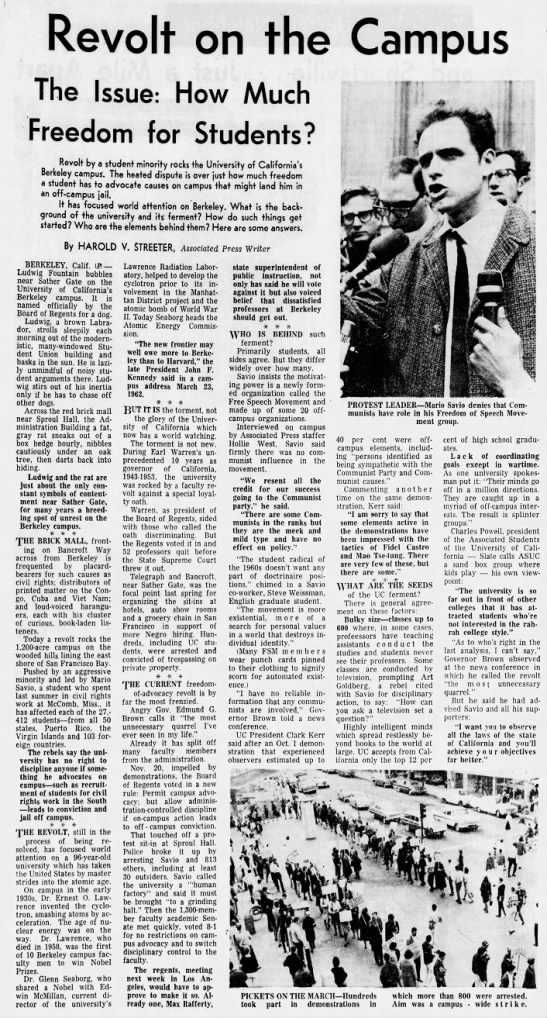
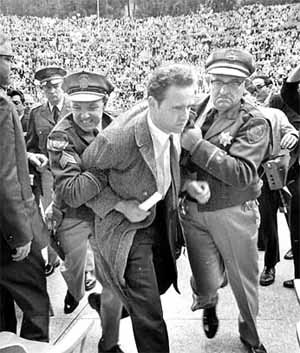
Savio’s part in the protest on the Berkeley campus started when on October 1, 1964, former student Jack Weinberg was manning a table for CORE. The University police had just put him in the police car when someone from the surrounding crowd yelled ‘sit down.’ Savio, along with others during the 32-hour sit-in, took off his shoes and climbed on top of the car and spoke with words that roused the crowd into frenzy.
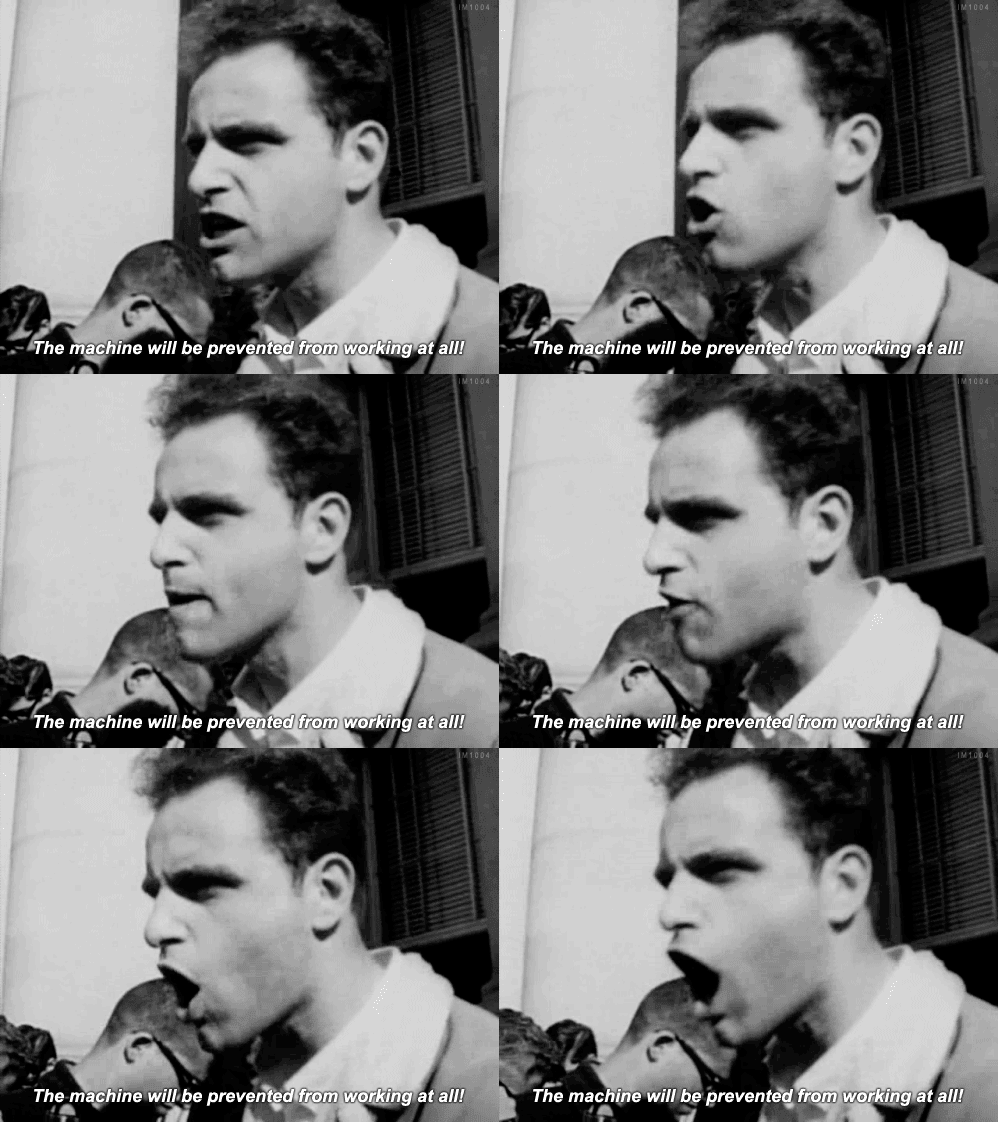
The last time he climbed on the police car was to tell the crowd of a short-term understanding that had been met with UC President Clark Kerr. Savio said to the crowd, "I ask you to rise quietly and with dignity, and go home", and the crowd did exactly what he said. After this Savio became the prominent leader of the newly formed Free Speech Movement. Negotiations failed to change the situation; therefore direct action began in Sproul Hall on December 2. There, Savio gave his most famous speech, on the "operation of the machine", in front of 4,000 people. He and 800 others were arrested that day. In 1967 he was sentenced to 120 days at Santa Rita Jail. He told reporters that ‘[he] would do it again.’
In April 1965, he quit the FSM because ‘he was disappointed with the growing gap between the leadership of the FSM … and the students themselves.’
"Bodies upon the gears" speech
"There's a time when the operation of the machine becomes so odious—makes you so sick at heart—that you can't take part. You can't even passively take part. And you've got to put your bodies upon the gears and upon the wheels, upon the levers, upon all the apparatus, and you've got to make it stop. And you've got to indicate to the people who run it, to the people who own it that unless you're free, the machine will be prevented from working at all." Sproul Hall Steps, December 2, 1964
Later life
Between 1965 and his death, Savio held a variety of jobs, including being a sales clerk in Berkeley. In 1965, he married Suzanne Goldberg, whom he had met at the Free Speech Movement. Two months after their wedding, they moved to England because Savio had won a scholarship to the University of Oxford. While there, they had their first child, Stefan. He did not complete his degree at Oxford due to emotional problems, and they moved back to California in February 1966. In 1968, he ran for state senator from Alameda County on the Peace and Freedom Party ticket, but lost to Nick Petris, a liberal Democrat.
In 1980, he married a second time, to Lynne Hollander, an old acquaintance from the Free Speech Movement. He returned to education at San Francisco State University during their marriage. In 1984, he received a summa cum laude bachelor’s degree in physics and earned a master’s degree in 1989. In 1990, Savio and Hollander moved with their 10-year-old son Daniel to Sonoma County, California, where he taught mathematics, philosophy and logic at Sonoma State University.
FBI controversy
In 1999, it was revealed that Savio had been trailed by the Federal Bureau of Investigation from the moment that he had climbed on to the police car that harbored Jack Weinberg. He was followed for more than a decade ‘because he had emerged as the nation’s most prominent student leader.’ There was no evidence that he was a threat or that he had any connection with the Communist Party, but the FBI decided he merited their attention because they thought he could inspire students to rebel.
Even when he had quit the FSM, the FBI called him to their Berkeley office. They told Savio that they had received letters of a threatening nature towards him, but they would not speak with Savio’s attorney present. However, he would not agree, and instead criticised the FBI ‘for failure to make arrests and take action in the South where human rights are being violated every day.’ At this point the meeting ended.
According to hundreds of pages of FBI files, the bureau:
* Collected, without court order, personal information about Savio from schools, telephone companies, utility firms and banks and compiled information about his marriage and divorce.
* Monitored his day-to-day activities by using informants planted in political groups, covertly contacting his neighbors, landlords and employers, and having agents pose as professors, journalists and activists to interview him and his wife.
* Obtained his tax returns from the Internal Revenue Service in violation of federal rules, mischaracterized him as a threat to the president and arranged for the CIA and foreign intelligence agencies to investigate him when he and his family traveled in Europe.
* Put him on an unauthorized list of people to be detained without judicial warrant in event of a national emergency, and designated him as a "Key Activist" whose political activities should be "disrupted" and "neutralized" under the bureau's illegal counterintelligence program known as COINTELPRO.
The investigation finally ended at the beginning of 1975 and at that point an investigation in to the FBI’s abuse of power began. Savio’s ex-wife, Suzanne Goldberg, said that the "FBI’s investigation of her and Savio [was] a waste of money and an invasion of privacy."
Death
Savio had a history of heart problems and was admitted to Columbia-Palm Drive Hospital in Sebastopol, California on November 2, 1996. He slipped into a coma on November 5 and died the following day, shortly after being removed from life support.
Legacy
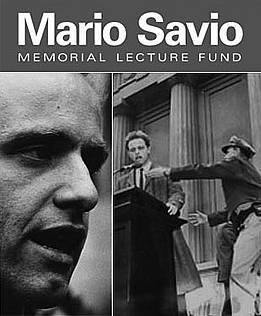
A Memorial Lecture Fund was set up to honor Mario Savio upon his death. The MSMLF hosts an annual fall lecture on the University of California, Berkeley campus. Past lecturers include Howard Zinn, Winona LaDuke, Lani Guinier, Barbara Ehrenreich, Arlie Russell Hochschild, Cornel West, Christopher Hitchens, Adam Hochschild, Amy Goodman, Molly Ivins, Jeff Chang, Tom Hayden, Angela Davis, Seymour Hersh, Robert F. Kennedy, Jr., Naomi Klein and Elizabeth Warren.
The Memorial Fund also set up the Mario Savio Young Activist Award to honor an outstanding activist under 30 with a deep commitment to human rights and social justice and the qualities of leadership ability, creativity, and integrity. Recipients of the award since it was first bestowed in 1998 include Michael Leon Guerrero, Niki Fortunato Bas, Jia Ching Chen, Jim Keady, Harmony Goldberg, Genevieve Gonzales, Rocio Nieves, Jason West, Erin Durban, Noemi Ramos, Christopher Goodman, Patrisse Marie Cullors, Julissa Bisono, Chelsea Chee, Timothy Den-Herder, Reyna Wences and Rigoberto Padilla-Perez.
In 1997, the steps of Sproul Plaza, from which he had given his most famous speech, were officially renamed the “Mario Savio Steps".
Mario's famous speech is sampled in many songs including "An Ounce Of Prevention" from the album On Little Known Frequencies by the band From Monument to Masses, "Timelessness" by the band Fear Factory, "The Movie's Over" by the Australian band Cog, "Article IV" by the Santa Cruz band Good Riddance, "Here Come The Pigs" by Deadsoul Tribe and "Wretches and Kings" from the album A Thousand Suns by Linkin Park. It is also paraphrased in an episode of Battlestar Galactica (Lay Down Your Burdens, Part II), given by a character playing the head of a union.
Biography
* Robert Cohen, Freedom's Orator: Mario Savio and the Radical Legacy of the 1960s (Oxford University Press, 2009). ISBN 978-0-19-518293-4
* Robert Cohen and Reginald E. Zelnik, eds., The Free Speech Movement: Reflections on Berkeley in the 1960s (University of California Press, 2002). ISBN 0-520-23354-9
(https://en.wikipedia.org)

--------------------
--------------------------------
Mp3 of the month: Wild Things- Another Colored Ink Drawing (A.C.I.D.)

Edited by Learyfan (12/06/20 12:36 PM)
|


 Threaded
 Previous
 Index
 Next
 Spores for European Microscopy
 Unfolding Nature: Being in the Implicate Order
 All-In-One Bags That Don't Suck
 Isolated Cubensis Liquid Culture For Sale
 Learyfan


 Salomon


 Edit
 Reply













 PrisonSong
 1 2 3 all )
 freddurgan

 Helge

 Silversoul

 eligal

 Redstorm
 mjshroomer

 Learyfan