- 1972: Jane Fonda goes to North Vietnam
Quote:
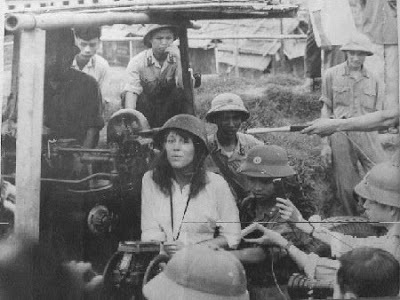
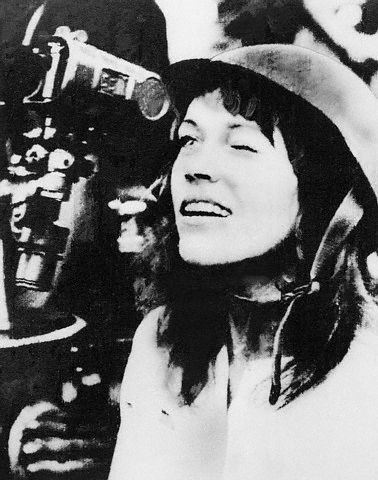
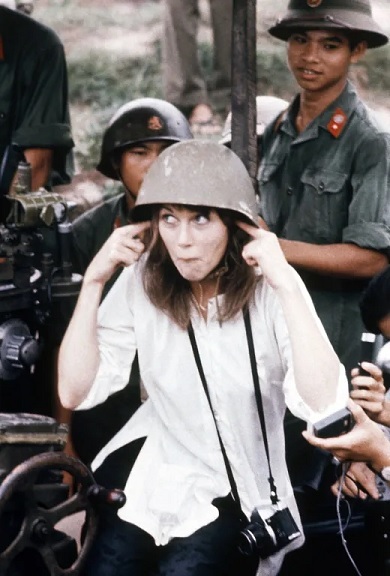
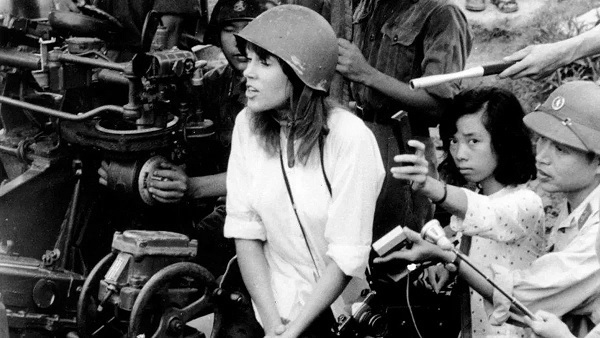
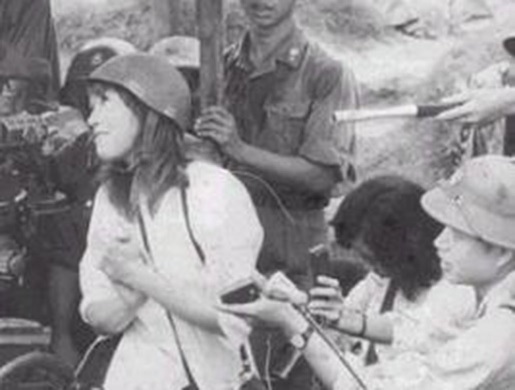
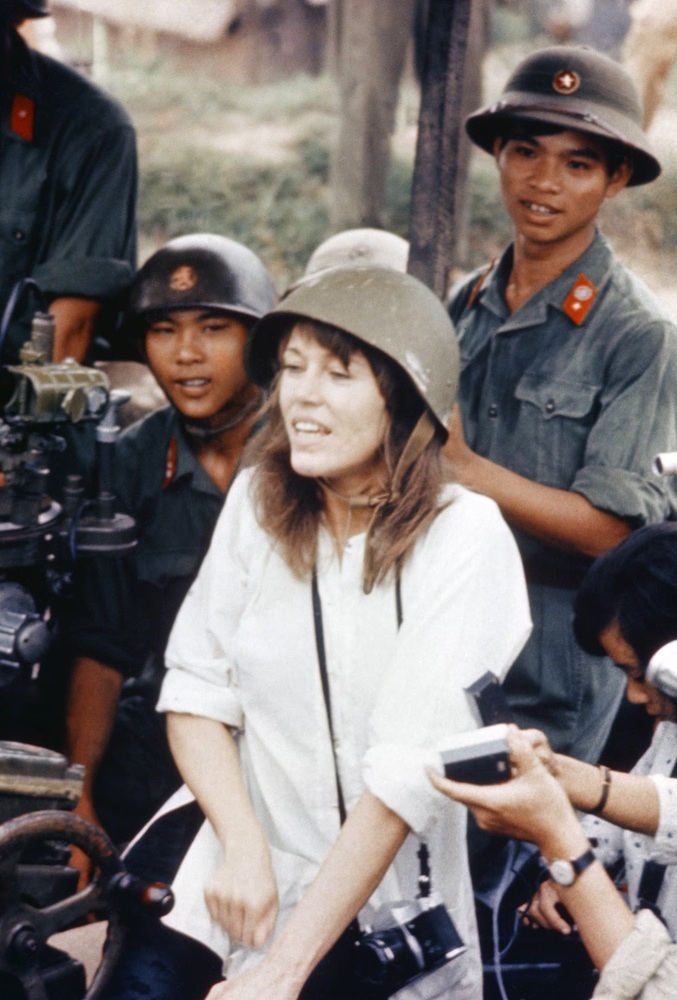
July 7, 1972 - Travels to North Vietnam for two weeks, during her visit she meets and poses for pictures with the Viet Cong at an anti-aircraft gun site. She also meets with American POWs and denounces "US imperialism" on Viet Cong radio. This trip earns her the nickname "Hanoi Jane."
(http://www.cnn.com)
Opposition to the Vietnam War
In April 1970, Fonda, with Fred Gardner and Donald Sutherland formed the FTA tour ("Free The Army", a play on the troop expression "Fuck The Army"), an anti-war road show designed as an answer to Bob Hope's USO tour. The tour, described as "political vaudeville" by Fonda, visited military towns along the West Coast, with the goal of establishing a dialogue with soldiers about their upcoming deployments to Vietnam. The dialogue was made into a movie (F.T.A.) which contained strong, frank criticism of the war by servicemen and servicewomen; it was released in 1972.
On May 4, 1970, Fonda appeared before an assembly at the University of New Mexico, in Albuquerque, to speak on GI rights and issues. The end of her presentation was met with a discomforting silence. The quiet was broken when Beat poet Gregory Corso staggered onto the stage. Drunk, Corso challenged Fonda, using a four-letter expletive: Why hadn't she addressed the shooting of four students at Kent State by the Ohio National Guard, which had just taken place? Fonda in her autobiography revisited the incident: "I was shocked by the news and felt like a fool." On the same day, she joined a protest march on the home of university president, Ferrel Heady. The protestors called themselves "They Shoot Students, Don't They?" – a reference to Fonda's recently released film, They Shoot Horses, Don't They?, which was just screened in Albuquerque.
In the same year, Fonda spoke out against the war at a rally organized by Vietnam Veterans Against the War (VVAW) in Valley Forge, Pennsylvania. She offered to help raise funds for VVAW and, for her efforts, was rewarded with the title of Honorary National Coordinator. On November 3, 1970, Fonda started a tour of college campuses on which she raised funds for the organization. As noted by The New York Times, Fonda was a "major patron" of the VVAW.
Controversial visit to Hanoi
Between 1965 and 1972, almost 300 Americans – mostly civil rights activists, teachers and pastors – traveled to North Vietnam to see firsthand the war situation with the Vietnamese. News media in the United States would only provide the official view from Washington, and American travelers to Vietnam were routinely harassed upon their return to the States. Fonda also visited Vietnam, traveling to Hanoi in July 1972 to witness firsthand the bombing damage to the dikes. After touring and photographing dike systems in North Vietnam, she said the United States had been intentionally targeting the dike system along the Red River. Columnist Joseph Kraft, who was also touring North Vietnam, said he believed the damage to the dikes was incidental and was being used as propaganda by Hanoi, and that, if the U.S. Air Force were "truly going after the dikes, it would do so in a methodical, not a harum-scarum way". Sweden's ambassador to Vietnam, however, observed the bomb damage to the dikes and described it as "methodic". Other journalists reported that the attacks were "aimed at the whole system of dikes".
Fonda was photographed seated on an anti-aircraft gun; the controversial photo outraged a number of Americans, and earned her the nickname "Hanoi Jane". In her 2005 autobiography, she wrote that she was manipulated into sitting on the battery; she had been horrified at the implications of the pictures and regretted taking them. In a 2011 entry at her official website, Fonda explained:
It happened on my last day in Hanoi. I was exhausted and an emotional wreck after the 2-week visit ... The translator told me that the soldiers wanted to sing me a song. He translated as they sung. It was a song about the day 'Uncle Ho' declared their country's independence in Hanoi's Ba Dinh Square. I heard these words: 'All men are created equal; they are given certain rights; among these are life, Liberty and Happiness.' These are the words Ho pronounced at the historic ceremony. I began to cry and clap. 'These young men should not be our enemy. They celebrate the same words Americans do.' The soldiers asked me to sing for them in return ... I memorized a song called 'Day Ma Di', written by anti-war South Vietnamese students. I knew I was slaughtering it, but everyone seemed delighted that I was making the attempt. I finished. Everyone was laughing and clapping, including me ... Here is my best, honest recollection of what happened: someone (I don't remember who) led me towards the gun, and I sat down, still laughing, still applauding. It all had nothing to do with where I was sitting. I hardly even thought about where I was sitting. The cameras flashed ... It is possible that it was a set up, that the Vietnamese had it all planned. I will never know. But if they did I can't blame them. The buck stops here. If I was used, I allowed it to happen ... a two-minute lapse of sanity that will haunt me forever ... But the photo exists, delivering its message regardless of what I was doing or feeling. I carry this heavy in my heart. I have apologized numerous times for any pain I may have caused servicemen and their families because of this photograph. It was never my intention to cause harm.
Fonda made radio broadcasts on Hanoi Radio throughout her two-week tour, commenting on her visits to villages, hospitals, schools, and factories damaged in the war and denouncing U.S. military policy in Vietnam. Fonda has defended her decision to travel to North Vietnam, and her radio broadcasts. During the course of her visit, Fonda visited American prisoners of war (POWs), and brought back messages from them to their families. When stories of torture of returning POWs were later being publicized by the Nixon administration, Fonda called the returning POWs "hypocrites and liars and pawns", adding about the prisoners she visited, "These were not men who had been tortured. These were not men who had been starved. These were not men who had been brainwashed." In addition, Fonda told The New York Times in 1973, "I'm quite sure that there were incidents of torture ... but the pilots who were saying it was the policy of the Vietnamese and that it was systematic, I believe that's a lie." Her visits to the POW camp led to persistent and exaggerated rumors which were repeated widely in the press and continued to circulate on the Internet decades later. Fonda, as well as the named POWs, have personally denied the rumors, and subsequent interviews with the POWs showed these rumored allegations to be false as the persons named had never met Fonda.
In 1972, Fonda helped fund and organize the Indochina Peace Campaign, which continued to mobilize antiwar activists across the nation after the 1973 Paris Peace Agreement, through 1975, when the United States withdrew from Vietnam.
Because of her tour of North Vietnam during wartime and the subsequent rumors circulated about her visit, resentment against her among some veterans and currently serving U.S. military still exists. For example, when a U.S. Naval Academy plebe ritually shouted out "Goodnight, Jane Fonda!", the entire company of midshipmen plebes, who had not yet been born when Fonda protested against the Vietnam War, replied "Goodnight, bitch!" This practice has since been prohibited by the academy's Plebe Summer Standard Operating Procedures. In 2005, Michael A. Smith, a U.S. Navy veteran, was arrested for disorderly conduct in Kansas City, Missouri, after he spat chewing tobacco in Fonda's face during a book-signing event for her autobiography, My Life So Far. He told reporters that he "consider[ed] it a debt of honor", adding "she spit in our faces for 37 years. It was absolutely worth it. There are a lot of veterans who would love to do what I did." Fonda refused to press charges.
Regrets
In a 1988 interview with Barbara Walters, Fonda expressed regret for some of her comments and actions, stating:
I would like to say something, not just to Vietnam veterans in New England, but to men who were in Vietnam, who I hurt, or whose pain I caused to deepen because of things that I said or did. I was trying to help end the killing and the war, but there were times when I was thoughtless and careless about it and I'm very sorry that I hurt them. And I want to apologize to them and their families. [...] I will go to my grave regretting the photograph of me in an anti-aircraft gun, which looks like I was trying to shoot at American planes. It hurt so many soldiers. It galvanized such hostility. It was the most horrible thing I could possibly have done. It was just thoughtless.
Some critics responded that her apology came at a time when a group of New England Veterans had launched a campaign to disrupt a film project she was working on, leading to the charge that her apology was motivated at least partly by self-interest.
In a 60 Minutes interview on March 31, 2005, Fonda reiterated that she had no regrets about her trip to North Vietnam in 1972, with the exception of the anti-aircraft-gun photo. She stated that the incident was a "betrayal" of American forces and of the "country that gave me privilege". Fonda said, "The image of Jane Fonda, Barbarella, Henry Fonda's daughter ... sitting on an enemy aircraft gun was a betrayal ... the largest lapse of judgment that I can even imagine." She later distinguished between regret over the use of her image as propaganda and pride for her anti-war activism: "There are hundreds of American delegations that had met with the POWs. Both sides were using the POWs for propaganda ... It's not something that I will apologize for." Fonda said she had no regrets about the broadcasts she made on Radio Hanoi, something she asked the North Vietnamese to do: "Our government was lying to us and men were dying because of it, and I felt I had to do anything that I could to expose the lies and help end the war."
Subject of government surveillance
In 2013, it was revealed that Fonda was one of approximately 1,600 Americans whose communications between 1967 and 1973 were monitored by the United States National Security Agency (NSA) as part of Project Minaret, a program that some NSA officials have described as "disreputable if not downright illegal". Fonda's communications, as well as those of her husband, Tom Hayden, were intercepted by Britain's Government Communications Headquarters (GCHQ). Under the UKUSA Agreement, intercepted data on Americans were sent to the U.S. government.
(https://en.wikipedia.org)

--------------------
--------------------------------
Mp3 of the month: Wild Things- Another Colored Ink Drawing (A.C.I.D.)

|

 Threaded
 Previous
 Index
 Next
 USA West Coast Strains
 Bulk Substrate
 Golden Teacher Liquid Culture For Sale
 Learyfan


 Edit
 Reply








 looner2

 Bullfrog1
 habitat0789

 evolprim

 ChiefGreenLeaf
 KingOftheThing

 1 2 3 4 5 all )
 Redstorm

