- 1947: Buddy Miles is born
Quote:
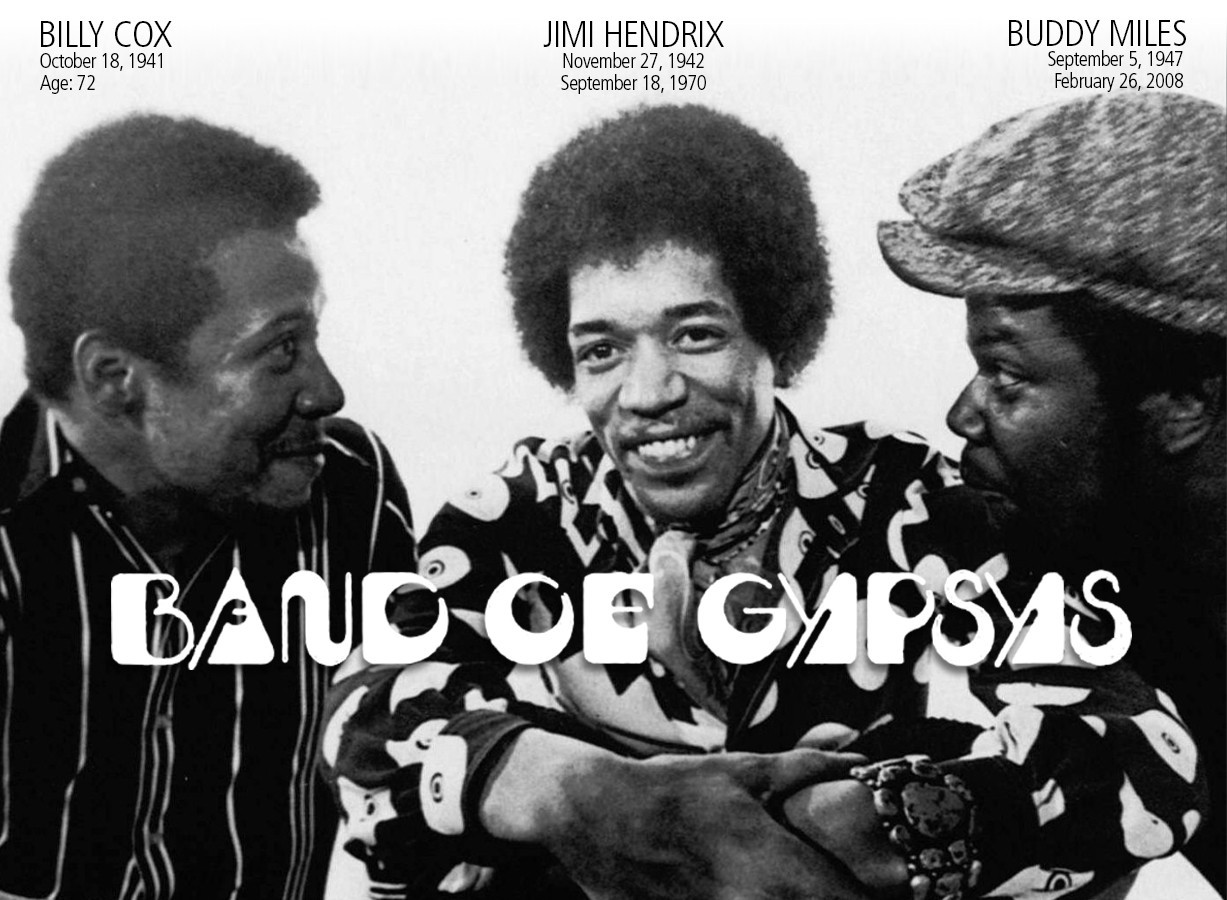
George Allen Miles, Jr. (September 5, 1947 – February 26, 2008), known as Buddy Miles, was an American rock and funk drummer, most known as a founding member of The Electric Flag in 1967, then as a member of Jimi Hendrix's Band of Gypsys from 1969 through to January 1970.
Early career
Jimi Hendrix
After Electric Flag Miles began a closer musical relationship with Hendrix and after Buddy Miles Express split up, Miles would begin the collaboration with the rock legend Jimi Hendrix, and bassist Billy Cox that produced the Band of Gypsys Lp. Miles had met Jimi Hendrix in an earlier time, when Miles was only sixteen and both were acting as sidemen for other artists in the early '60s. The meeting had occurred in Canada in 1964, at a show both were participating in.
Miles said of his first meeting with Hendrix: "He was playing in the Isley Brothers band and I was in Ruby and the Romantics ... [Jimi] had his hair in a pony-tail with long sideburns. Even though he was shy I could tell this guy was different. He looked rather strange, because everyone else was wearing uniforms and he was eating his guitar, doing flip-flops and wearing chains." Although all photographs, (and there are several of him with the Isley Bros), of Hendrix paying in bands prior to his move into Greenwich Village, in late 1966, as 'The Blue Flame' show him wearing band uniform, with no sideburns to speak of and only fashionable, moderately longish processed hair, certainly nothing you could tie in a pony tail. This prefaced a later friendship that would result in several jams and the occasional unreleased recording with Hendrix. In 1967, Hendrix and Miles jammed at the Malibu home of Stephen Stills, and went on to play together again at various times, in both Los Angeles and New York in 1968. Hendrix occasionally joined Electric Flag on stage. On the recordings for Electric Ladyland Hendrix used some guest artists, one of them being Buddy Miles who played on the songs "Rainy Day, Dream Away" and "Still Raining, Still Dreaming", which are actually the same long jammed song cut in half with 1983 a Merman I Should Turn To Be edited in between.
In 1969 Hendrix found time to write a short poem as a liner note to Expressway To Your Skull and to later produce four of the tracks on its follow up Electric Church, the two studio Lp's released by Buddy Miles Express. The title of the latter Lp being taken from Hendrix's poem on the first. There was also obvious public curiosity as to whether the name of the band "Buddy Miles Express" was influenced by Hendrix's act, "Jimi Hendrix Experience".
After the Jimi Hendrix Experience split, Hendrix formed Gypsy Sun & Rainbows, which featured Mitch Mitchell back on drums again, and Billy Cox on bass, amongst others. Then this group was dibanded in late September 1969 with nothing that was deemed releasable from their sessions. They had though recorded complete versions of Message To Love and Machine Gun, songs which would feature on the Band of Gypsys LP, the two songs that would comprise the Band of Gypsys single: Stepping Stone and Izabella and another song the Band of Gypsys worked on too, but didn't finish: Burning Desire. Between late September and mid October 1969, according to Buddy Miles: "Jimi was not happy. He felt powerless. He couldn't do what he wanted to do.". Hendrix's solution to the problem, in mid October 1969, was to found a short-lived band called Band of Gypsys and Miles was brought in to join him. Alan Douglas and Stephan Bright were initially brought in to "produce" their recording sessions, but Cox immediately clashed with the pair deeming them unworthy. He eventually stormed out of the sessions after a furious row with Bright and went home to Nashville for two weeks, before being coaxed back. And at the end of Douglas and Bright's one and a half months they had only produced one usable backing track: Room Full of Mirrors. Douglas (and therefore Bright, his employee) resigned stating business pressure, pressure from Hendrix' manager Michael Jeffery, and Hendrix' own "lack of interest". The same day as Douglas resigned Hendrix signed the contract with Bill Graham for the two dates. Hendrix had been talking about a "Band of Gypsys" "jam" Lp since late 1968, after the settlement with Chalpin. He also introduced the band known as 'Gypsy Sun & Rainbows' who he introduced by that name, but also almost in the same breath as 'Band of Gypsys' during their 'Woodstock' concert - only credited as 'Jimi Hendrix' on the two Woodstock Lp's. One of the notable features for his audience at the time was the fact that all of the players were black. This was a first for Hendrix as an international recording star – although he had, of course, played with the Isley Brothers and Little Richard, amongst several other r&b bands in his early days – and this choice has been seen by some as a move toward reconnecting with his soul roots. It has also been seen as having had the effect of re-associating rock with its African American roots. Originally it was a single LP , but additional cuts from the concerts have been released on a double CD Live at the Fillmore East. During the two and a half months run up to the two night's recordings for the Lp, the band rehearsed and recorded in New York City where Hendrix had his apartement, where his management was, where he was building his Electric Lady studio, and where he had lived and recorded since moving there from Nashville in 1964 - apart from his sixteen months "exile" in London, a later two month sojourn there in 1969, and his West Coast tours when he would base himself in L.A. Hendrix had become entangled in legal litigation concerning the contract with Ed Chalpin's PPX he had signed to prior to his agreement with Jeffery & Chandler and becoming internationally recognized. He was required to give his next Lp to Ed Chalpin to be released by the Capitol Records label as part of the agreement in court. This fact led to Buddy Miles and Billy being hired as full time employees (with benefits) for the duration of this three month collaboration called the 'Band of Gypsys' that produced that Lp for Chalpin and Capitol and a single for Reprise.
Hendrix during a, one off, charity event a month later (for the Moratorium to End the War in Vietnam committee), had a minor, possibly drug-related (opinions differ) meltdown on stage which has also been speculated to have been an act of sabotage on the part of a very frustrated manager Michael Jeffery, who was not a fan of the Band of Gypsys, and has been claimed as fact by Miles. Miles had this to say about the incident years later:
"Jeffery slipped [Jimi] two half-tabs of acid on stage as he went on ... [Jimi] just freaked out. I told Jeffery he was an out-and-out complete idiot and a fucking asshole to boot. One of the biggest reasons why Jimi is dead is because of that guy." Miles and Jeffery already had a strained relationship, as Jeffery was always uncomfortable with Hendrix and Miles' close friendship. After this, one off, charity event at Madison Square Garden in January 1970, Jeffery told Buddy Miles he was fired and the Band of Gypsys was no more. Although Cox, and presumably Miles as well, had already been paid off as full-time salaried employees, with a $1,000 bonus "for their services" the week before.
Besides recording the live Lp, studio recordings were made during the rehearsals leading up to the two concert dates and continued sporadically over a further three weeks. Cox and Miles' recording for the single's A side was completed on the 7th, and the only other completed backing track was Power of Soul on the 21st. At this point most of Hendrix' and Eddie Kramer's time was taken up with (Hendrix only) overdubs and mixing of the studio tracks. As well as the beginning of the very long mixing and editing for the finished Lp. Some of these songs were marked down by Hendrix as contenders for his next Lp. The songs are: "Room Full of Mirrors", "Ezy Ryder", "Power of Soul" and the Band of Gypsys single "Stepping Stone" b/w "Izabella", released a week after the LP, but back on Reprise records. This original version of "Stepping Stone" was later given new guitar overdubs, Miles' drums were replaced by Mitchell and it was re-mixed by Hendrix, towards releasing it on his next Lp. These songs have been released in several posthumous Hendrix albums. The album Band of Gypsys — released in March 1970 (US) June (UK)— made the Top 10 on both sides of the Atlantic, and stayed in the US charts for over a year. Hendrix' final extensive tour (he had only played five major concerts (one morning and two nights) in the previous nine months since the original 'Experience' broke up - not counting his last a very disappointing two song show at Madison Square Gardens and these were all in New York City apart 'Woodstock' in New York state) and his tragic early death on the back off it on September 18, 1970, causing the album to sell more and for a longer period. There are now videos of Buddy and Randy Hansen covering several of Jimi's songs on a major website.
Death
Buddy Miles died on February 26, 2008, at his home in Austin, Texas at the age of 60. His family was by his side. According to his website he died of congestive heart disease.
(https://en.wikipedia.org)
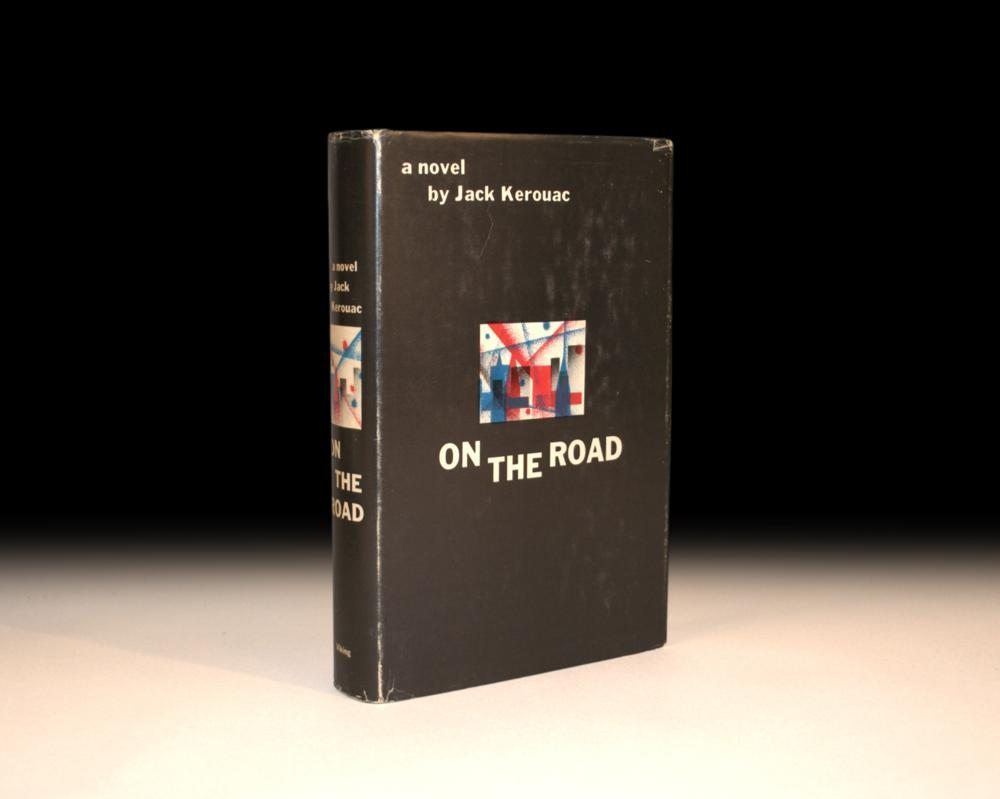
- 1957: Jack Kerouac releases On The Road
Quote:
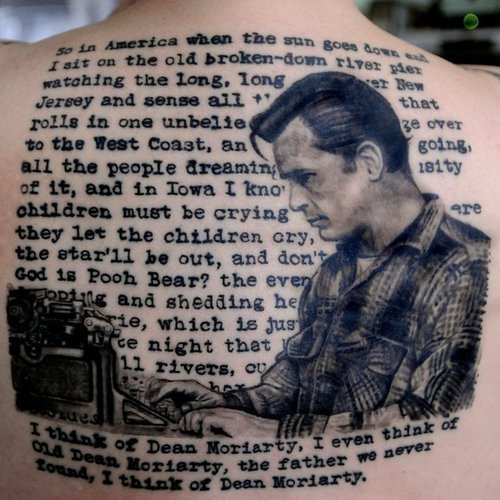
On the Road is a novel by American writer Jack Kerouac, based on the travels of Kerouac and his friends across the United States. It is considered a defining work of the postwar Beat and Counterculture generations, with its protagonists living life against a backdrop of jazz, poetry, and drug use. The novel, published in 1957, is a roman à clef, with many key figures in the Beat movement, such as William S. Burroughs (Old Bull Lee), Allen Ginsberg (Carlo Marx) and Neal Cassady (Dean Moriarty) represented by characters in the book, including Kerouac himself as the narrator Sal Paradise.
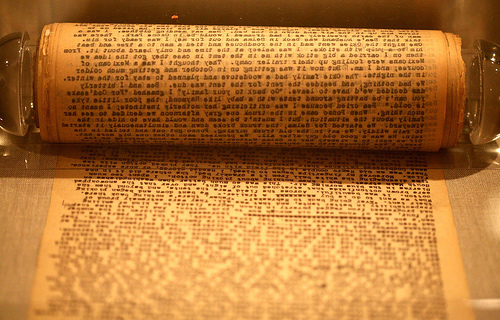
The idea for On the Road, Kerouac's second novel, was formed during the late 1940s in a series of notebooks, and then typed out on a continuous reel of paper during three weeks in April 1951. It was first published by Viking Press in 1957. After several film proposals dating from 1957, the book was finally made into a film, On the Road (2012), produced by Francis Ford Coppola and directed by Walter Salles.
When the book was originally released, The New York Times hailed it as "the most beautifully executed, the clearest and the most important utterance yet made by the generation Kerouac himself named years ago as 'beat,' and whose principal avatar he is." In 1998, the Modern Library ranked On the Road 55th on its list of the 100 best English-language novels of the 20th century. The novel was chosen by Time magazine as one of the 100 best English-language novels from 1923 to 2005.
Characters
Kerouac often based his fictional characters on friends and family.
"Because of the objections of my early publishers I was not allowed to use the same personae names in each work."
Real-life person Character name
Jack Kerouac Sal Paradise
Gabrielle Kerouac (Jack Kerouac's mother) Sal Paradise's Aunt
Joan Kerouac (born Haverty) Laura
Alan Ansen Rollo Greb
William S. Burroughs Old Bull Lee
Joan Vollmer Adams Burroughs Jane Lee
William S. Burroughs, Jr. Ray Lee
Julie Burroughs Dodie Lee
Lucien Carr Damion
Neal Cassady Dean Moriarty
Neal Cassady, Sr. Old Dean Moriarty
Neal Cassady's cousin Sam Brady
Carolyn Cassady Camille
Jamie Cassady Joanie Moriarty
Catherine Cassady Amy Moriarty
Bea Franco (Beatrice Kozera) Terry
Allen Ginsberg Carlo Marx
John Clellon Holmes Ian MacArthur
Herbert Huncke Elmer Hassel
William Holmes “Big Slim” Hubbard William Holmes “Big Slim” Hazard
Ruth Gullion Rita Bettencourt
Helen Gullion Mary Bettencourt
Diana Hansen Inez
Beverly Burford Babe Rawlins
Bob Burford Ray Rawlins
Dianne Orin Lee Ann
Henri Cru Remi Boncœur
Paul Blake (Jack Kerouac’s brother-in-law) Rocco
Al Hinkle Ed Dunkel
Helen Hinkle Galatea Dunkel
Bill Tomson Roy Johnson
Helen Tomson (Bill Tomson's wife) Dorothy Johnson
Jim Holmes Tommy Snark
Gregorio Victor
Frank Jeffries Stan Shepard
Gene Pippin Gene Dexter
Jinny Baker Lehrman Jinny Jones
Victor Tejeira Victor Villanueva
Walter Adams Walter Evans
Jose García Villa Angel Luz García
Ed Uhl Ed Wall
Justin W. Brierly Denver D. Doll
Ed White Tim Gray
Joanie White (Ed White's sister) Betty Gray
LuAnne Henderson Marylou
Pauline Lucille
Vicki Russell Dorie, “Tall redhead”
Rhoda Mona
Ed Stringham Tom Saybrook
Kells Elvins Dale
Lorraine Marie
Alan Harrington Hal Hingham
Ginger Chase Peaches
Haldon "Hal" Chase Chad King
Allan Temko Roland Major
Gregory La Cava "The famous director"
Mr. Snow
Influence
On the Road has been an influence on various poets, writers, actors and musicians, including Bob Dylan, Van Morrison, Jim Morrison, Jerry Garcia and Hunter S. Thompson.
From journalist Sean O'Hagan, in a 2007 article published in The Guardian:
" 'It changed my life like it changed everyone else's,' Dylan would say many years later. Tom Waits, too, acknowledged its influence, hymning Jack and Neal in a song and calling the Beats "father figures." At least two great American photographers were influenced by Kerouac: Robert Frank, who became his close friend—Kerouac wrote the introduction to Frank's book, The Americans—and Stephen Shore, who set out on an American road trip in the 1970s with Kerouac's book as a guide. It would be hard to imagine Hunter S. Thompson's road novel Fear and Loathing in Las Vegas had On the Road not laid down the template; likewise, films such as Easy Rider, Paris, Texas, and even Thelma and Louise. "
In his book Light My Fire: My Life with The Doors, Ray Manzarek (keyboard player of The Doors) wrote "I suppose if Jack Kerouac had never written On the Road, The Doors would never have existed."
On the Road influenced an entire generation of musicians, poets, and writers including Allen Ginsberg. Because of Ginsberg’s friendship with Kerouac, Ginsberg was written into the novel through the character Carlo Marx. Ginsberg recalled that he was attracted to the beat generation, and Kerouac, because the beats valued “detachment from the existing society,” while at the same time calling for an immediate release from a culture in which the most "freely" accessible items—bodies and ideas—seemed restricted. Ginsberg incorporated a sense of freedom of prose and style into his poetry as a result of the influence of Kerouac.
Author Jack Kerouac
Country United States
Language English
Genre Beat
Publisher Viking Press
Publication date
September 5, 1957
Media type Print (hardback & paperback)
Pages 320 pages
OCLC 43419454
Preceded by The Town and the City
(1950)
Followed by The Subterraneans
(1958)
(https://en.wikipedia.org)
- 1965: The term "hippie" is publicly applied to the San Francisco counterculture
Quote:
The First Time The Mainstream Media Wrote About Hippies
by LITTLE HIPPIE
May 12, 2015
We got curious about Dennis McNally’s reference in A Long Strange Trip, to a 1965 series of San Francisco Examiner articles by Michael Fallon. The articles are referenced in almost every major book about the era, as the first use of the word hippie in print – derived from the beatnik’s hipster – to describe the shifting culture of the San Francisco scene, beginning with “A New Paradise For Beatniks.”
What goes around, comes around, from hipsters to hippies to hipsters once again. As this September will be the fiftieth anniversary of the publication of the series, we decided to dig into the San Francisco Public Library microfiche to get the primary source material, presented again in a series.
Stay tuned for more articles from this series! Let us know what you think or remember from this time in media by commenting.
(http://blog.littlehippie.com)
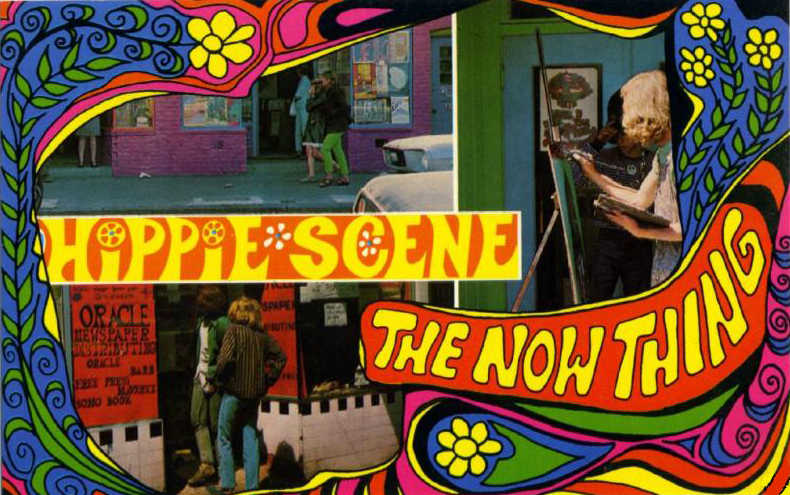
Although the word hippies made other isolated appearances in print during the early 1960s, the first use of the term on the West Coast appeared in the article "A New Paradise for Beatniks" (in the San Francisco Examiner, issue of September 5, 1965) by San Francisco journalist Michael Fallon. In that article, Fallon wrote about the Blue Unicorn Cafe (coffeehouse) (located at 1927 Hayes Street in the Haight-Ashbury district of San Francisco), using the term hippie to refer to the new generation of beatniks who had moved from North Beach into the Haight-Ashbury district. New York Times editor and usage writer Theodore M. Bernstein said the paper changed the spelling from hippy to hippie to avoid the ambiguous description of clothing as hippy fashions.
(https://en.wikipedia.org)

Edited by Learyfan (09/05/20 11:35 AM)
|

 Threaded
 Previous
 Index
 Next
 Isolated Cubensis Liquid Culture For Sale
 USA West Coast Strains
 Learyfan


 Edit
 Reply







 you learyfan you da shit
 How the hell did I miss that? Maybe they just recently added the publishing date on Wikipedia. I must have looked for it in the past to no luck? But thank you so much! I've added it. And it's the 60th anniversary, but still, good f'n call my friend!





 Learyfan

 1 2 all )

 PrisonSong
 freddurgan
