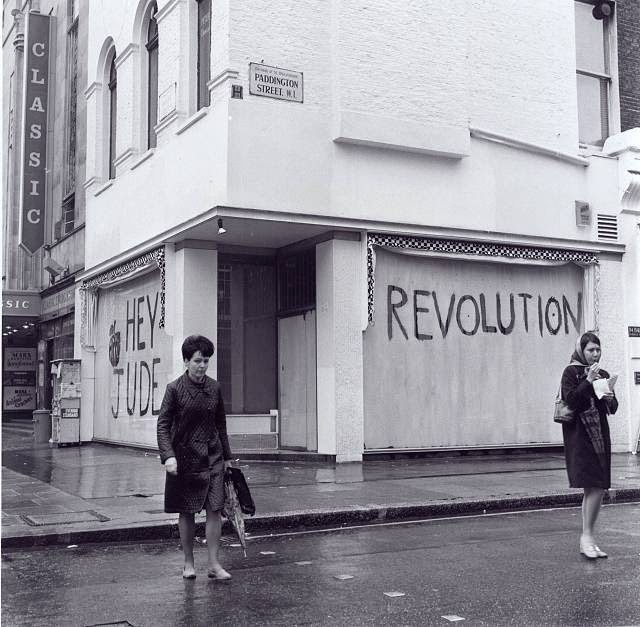
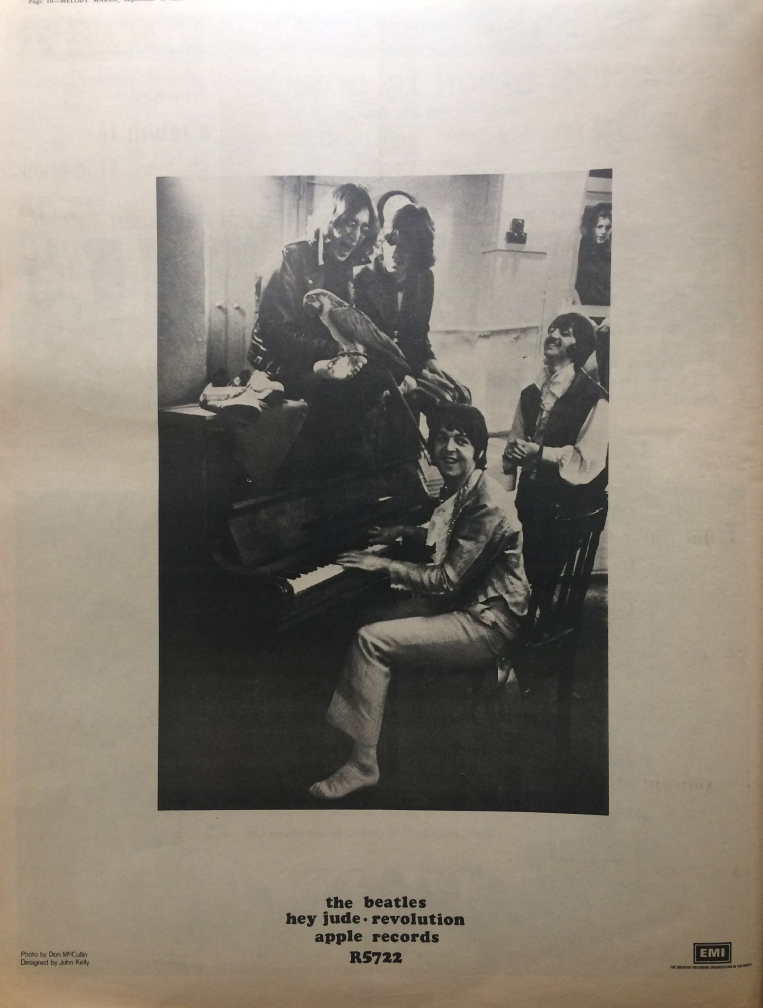
- 1968: The Beatles release the single for "Hey Jude" b/w "Revolution"
Quote:
"Hey Jude" is a song by the English rock band The Beatles. Credited to Lennon/McCartney, the ballad evolved from "Hey Jules", a song Paul McCartney wrote to comfort John Lennon's son Julian during his parents' divorce. "Hey Jude" begins with a verse-bridge structure based around McCartney's vocal performance and piano accompaniment; further instrumentation is added as the song progresses to distinguish sections. After the fourth verse, the song shifts to a fade-out coda that lasts for more than four minutes.
"Hey Jude" was released in August 1968 as the first single from The Beatles' record label Apple Records. More than seven minutes in length, "Hey Jude" was, at the time, the longest single ever to top the British charts. It also spent nine weeks as number one in the United States—the longest run at the top of the American charts for a Beatles' single, and tied the record for longest stay at #1 (until the record was broken by "You Light Up My Life"). The single has sold approximately eight million copies and is frequently included on professional lists of the all-time best songs.
B-side "Revolution"
Released 26 August 1968
Format 7"
Recorded 31 July 1968 at
Trident Studios, London
Genre Rock, pop[1]
Length
7:11 (mono)
7:06 (stereo)
Label Apple
Writer(s) Lennon/McCartney
Producer George Martin
Certification 4× Platinum (RIAA)
(https://en.wikipedia.org)
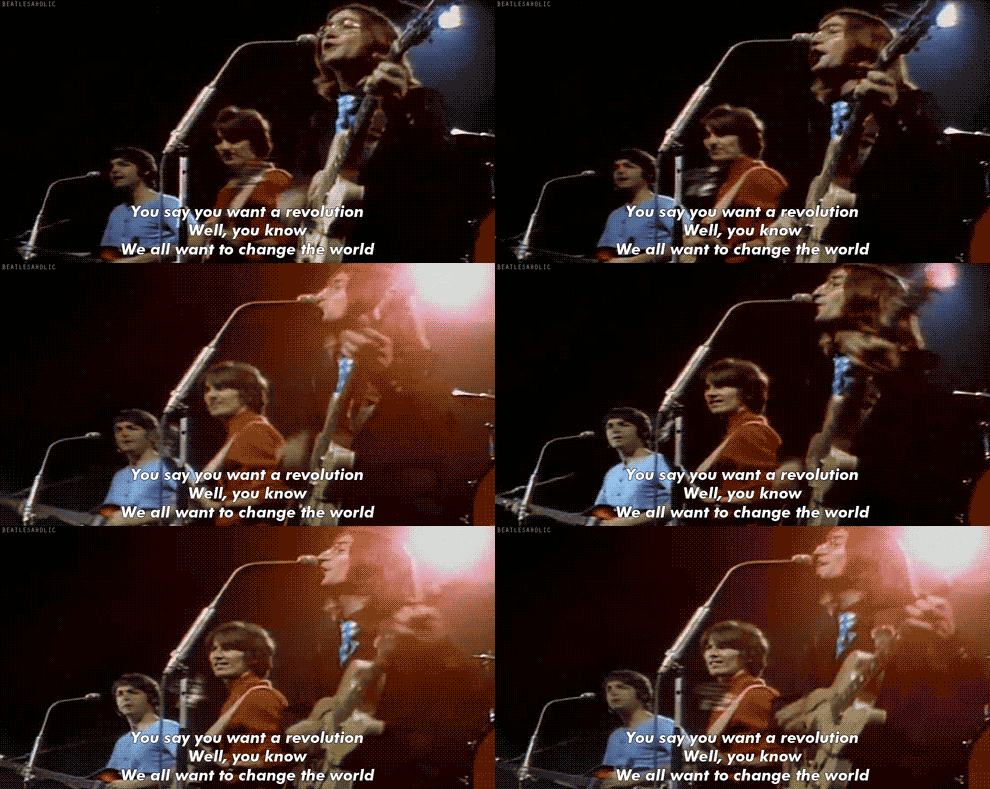
"Revolution" is a song by The Beatles written by John Lennon and credited to Lennon/McCartney. The Beatles released two distinct arrangements of the song in 1968: a hard rock version as the B-side of the single "Hey Jude", and a slower version titled "Revolution 1" on the eponymous album The Beatles (commonly called the "White Album"). Although "Revolution" was released first, it was recorded several weeks after "Revolution 1" as a re-make specifically designed to be released as a single. A third connected piece written by Lennon is the experimental "Revolution 9", which evolved from an unused portion of "Revolution 1", and also appears on the White Album.
"Revolution" was inspired by political protests in early 1968. Lennon's lyrics expressed doubt about some of the tactics. When the single version was released in August, the political left viewed it as betraying their cause. The release of the album version in November indicated Lennon's uncertainty about destructive change, with the phrase "count me out" modified to "count me out, in". In 1987, the song became the first Beatles recording to be licensed for a television commercial, which prompted a lawsuit from the surviving members of the group.
Background and composition
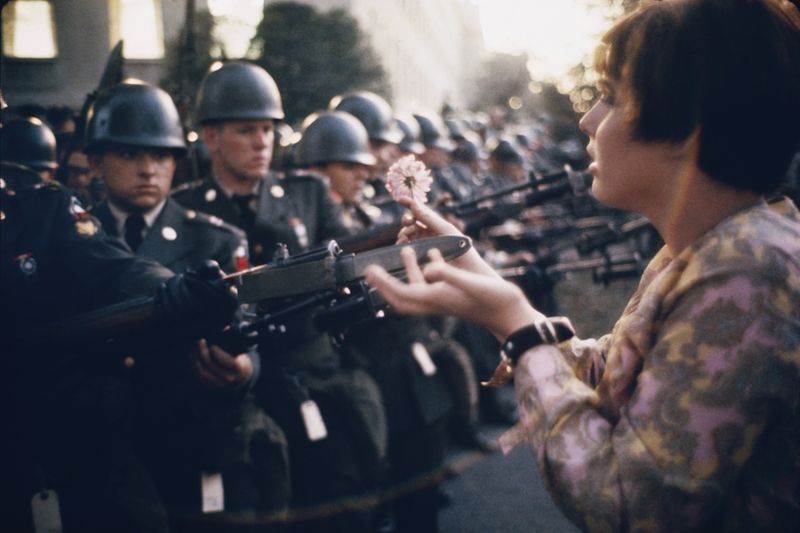
In early 1968, media coverage in the aftermath of the Tet Offensive spurred increased protests in opposition to the Vietnam War, especially among university students. The protests were most prevalent in the US, but on 17 March several thousand demonstrators marched to the American embassy in London's Grosvenor Square and violently clashed with police. Major protests concerning other political issues made international news, such as the March 1968 protests in Poland against their communist government, and the campus uprisings of May 1968 in France.
The Beatles had avoided expressing political viewpoints, with "Taxman" being their only prior song with an overt political topic. During his time in Rishikesh, Lennon decided to write a song about the recent wave of social upheaval. He recalled, "I thought it was about time we spoke about it [revolution], the same as I thought it was about time we stopped not answering about the Vietnamese war. I had been thinking about it up in the hills in India."
Despite Lennon's antiwar feelings, he had yet to become anti-establishment, and expressed in "Revolution" that he wanted "to see the plan" from those advocating toppling the system. The repeated phrase "it's gonna be alright" in "Revolution" came directly from Lennon's Transcendental Meditation experiences in India, conveying the idea that God would take care of the human race no matter what happened politically. Another influence on Lennon was his burgeoning relationship with avant-garde artist Yoko Ono; Ono attended the recording sessions, and participated in the unused portion of "Revolution 1" which evolved into "Revolution 9".
Around the fourth week of May 1968, The Beatles met at Kinfauns (George Harrison's home in Esher) to demonstrate their compositions to each other in preparation for recording their next studio album. A bootleg recording from that informal session shows that "Revolution" had two of its three verses intact. The line referencing Mao Zedong was added to the lyrics in the studio. During filming of a promotional clip later that year, Lennon told the director that it was the most important lyric of the song. Lennon had changed his mind by 1972, saying "I should have never put that in about Chairman Mao".
Revolution (single version)
Lennon wanted "Revolution 1" to be the next Beatles single, but McCartney was reluctant to invite controversy, and argued along with Harrison that the track was too slow for a single. Lennon persisted, and rehearsals for a faster and louder re-make began on 9 July; recording started the following day.
The song begins with "a startling machine-gun fuzz guitar riff", with Lennon's and Harrison's guitars prominent throughout the track. The distinctive distorted guitar sound was achieved by direct injection of the guitar signal into the mixing console. Emerick further explained that he routed the signal through two microphone preamplifiers in series while he kept the amount of overload just below the point of overheating the console. Lennon overdubbed the opening scream, and double-tracked some of the words "so roughly that its careless spontaneity becomes a point in itself".
"Revolution" was performed in a higher key, B major, compared to the A major of "Revolution 1", although the distortion changes the key slightly. The "shoo-bee-do-wah" backing vocals were omitted in the re-make, and an instrumental break was added. "Revolution" was given a climactic end, as opposed to the fade out of "Revolution 1". For this version, Lennon unequivocally sang "count me out". A piano overdub by Nicky Hopkins was added 11 July, with final overdubs on 13 July and mono mixing on 15 July.
Use in Nike advertisement
In 1987, "Revolution" became the first Beatles recording to be licensed for use in a television commercial. Nike paid $500,000 for the right to use the song for one year, split between recording owner Capitol-EMI and song publisher ATV Music Publishing (owned by Michael Jackson). Commercials using the song started airing in March 1987.
“If it's allowed to happen, every Beatles song ever recorded is going to be advertising women's underwear and sausages. We've got to put a stop to it in order to set a precedent. Otherwise it's going to be a free-for-all. It's one thing when you're dead, but we're still around! They don't have any respect for the fact that we wrote and recorded those songs, and it was our lives.”
— George Harrison (November 1987)
The three surviving Beatles, through their record company Apple, filed a lawsuit in July 1987 objecting to Nike's use of the song. The suit was aimed at Nike, its advertising agency Wieden+Kennedy, and Capitol-EMI Records. Capitol-EMI said the lawsuit was groundless because they had licensed the use of "Revolution" with the "active support and encouragement of Yoko Ono Lennon, a shareholder and director of Apple". Ono had expressed approval when the commercial was released, saying the commercial "is making John's music accessible to a new generation".
The "Revolution" lawsuit and others involving The Beatles and EMI were settled out of court in November 1989, with the terms kept secret. The financial website TheStreet.com included the Nike "Revolution" advertisement campaign in its list of the 100 key business events of the 20th century, as it helped "commodify dissent".
A-side "Hey Jude"
Released 26 August 1968
Format 45 rpm
Recorded 9–13 July 1968
Genre Hard rock
Length 3:21
Label Apple
Writer(s) Lennon/McCartney
Producer George Martin
(https://en.wikipedia.org)
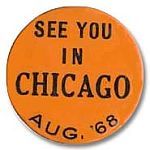
- 1968: First day of 1968 Democratic National Convention
Quote:
The 1968 Democratic National Convention of the U.S. Democratic Party was held at the International Amphitheatre in Chicago, Illinois, from August 26 to August 29, 1968. Because Democratic President Lyndon Johnson had announced he would not seek a second term, the purpose of the convention was to select a new nominee to run as the Democratic Party’s candidate for the office. The keynote speaker was Senator Daniel Inouye (D-Hawaii).
The convention was held during a year of violence, political turbulence, and civil unrest, particularly riots in more than 100 cities following the assassination of Martin Luther King, Jr. on April 4. The convention also followed the assassination of Democratic presidential hopeful Senator Robert F. Kennedy, who had been shot on June 5. Both Kennedy and Senator Eugene McCarthy had been running against the eventual Democratic presidential nominee Hubert Humphrey.
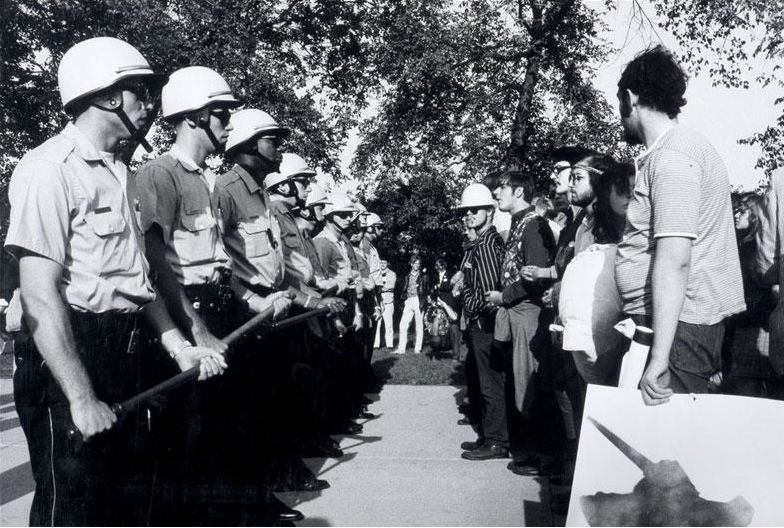
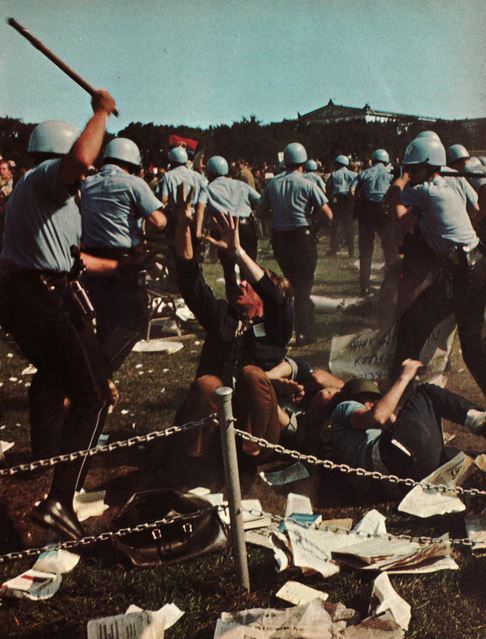
Chicago's mayor, Richard J. Daley, intended to showcase his and the city's achievements to national Democrats and the news media. Instead, the proceedings became notorious for the large number of demonstrators and the use of force by the Chicago police during what was supposed to be, in the words of the Yippie activist organizers, “A Festival of Life.” Rioting took place between demonstrators and the Chicago Police Department, who were assisted by the Illinois National Guard. The disturbances were well publicized by the mass media, with some journalists and reporters being caught up in the violence. Network newsmen Mike Wallace and Dan Rather were both roughed up by the Chicago police while inside the halls of the Democratic Convention.
Protests and police response
In 1967, the Yippie movement had already begun planning a youth festival in Chicago to coincide with the Democratic National Convention. They were not alone; other groups, such as Students For a Democratic Society and the National Mobilization Committee to End the War in Vietnam, also made their presence known. When asked about anti-war demonstrators, Daley kept repeating to reporters that “No thousands will come to our city and take over our streets, or city, our convention.” In the end, 10,000 demonstrators gathered in Chicago for the convention where they were met by 23,000 police and National Guardsmen. Daley also thought that one way to prevent demonstrators from coming to Chicago was to refuse to grant permits which would allow for people to protest legally.
After the violence which took place at the Chicago convention, Daley claimed his primary reason for calling in so many Guardsmen and police was reports he received indicating the existence of plots to assassinate many of the leaders, including himself.
While several protests had taken place before serious violence occurred, the events headed by the Yippies were not without comedy. Surrounded by reporters on August 23, 1968, Jerry Rubin, a Yippie leader, folk singer Phil Ochs, and other activists held their own presidential nominating convention with their candidate Pigasus, an actual pig. When the Yippies paraded Pigasus at the Civic Center, ten policemen arrested Rubin, Pigasus, and six others. This resulted in Pigasus becoming a media hit.
August 28, 1968 came to be known as the day a “police riot” took place. The title of “police riot” came out of the Walker Report, which amassed a great deal of information and eyewitness accounts to determine what happened in Chicago. At approximately 3:30 p.m., a young boy lowered the American flag at a legal rally taking place at Grant Park. The demonstration was made up of 10,000 protestors. The police broke through the crowd and began beating the boy, while the crowd pelted the police with food, rocks, and chunks of concrete. The biggest clash in Chicago took place that day. Police fought with the protestors and vice versa. The chants of the protestors shifted from “Hell no, we won’t go” to “Pigs are whores.” Tom Hayden, one of the leaders of Students for a Democratic Society, encouraged protestors to move out of the park to ensure that if they were to be tear gassed, the whole city would be tear gassed, and made sure that if blood were spilled in Chicago it would happen throughout the city. The amount of tear gas used to suppress the protestors was so great that it eventually made its way to the Hilton Hotel, where it disturbed Hubert Humphrey while in his shower. The police were taunted by the protestors with chants of “Kill, kill, kill.” They sprayed demonstrators and bystanders indiscriminately with Mace. The police assault in front of the Hilton Hotel became the most famous image of the Chicago demonstrations of 1968. The entire event took place live under the T.V. lights for seventeen minutes with the crowd shouting, “The whole world is watching.”
Meanwhile, in the convention hall, Connecticut Senator Abraham Ribicoff used his nominating speech for George McGovern to tell of the violence going on outside the convention hall, saying that “with George McGovern we wouldn’t have Gestapo tactics on the streets of Chicago.” Mayor Daley responded to his remark with something that the T.V. sound was not able to pick up, but it was later revealed by lip-readers that Daley had cursed “Fuck you, you Jew son of a bitch! You lousy motherfucker! Go home!” That night, NBC News had been switching back and forth between the demonstrators being beaten by the police to the festivities over Humphrey’s victory in the convention hall. It was under the cameras of the convention center, for all of America to see. It was clear that the Democratic party was sorely divided. After the Chicago protests, the demonstrators were confident that the majority of Americans would side with them over what had happened in Chicago, especially because of police behavior. They were shocked to learn that controversy over the war in Vietnam overshadowed their cause. Daley claimed to have received 135,000 letters supporting his actions and only 5000 condemning them. Public opinion polls demonstrated that the majority of Americans supported the Mayor’s tactics.
The Chicago Seven
After Chicago, the Justice Department meted out conspiracy and incitement to riot charges in connection with the violence at Chicago and gave birth to the Chicago Eight, which consisted of Abbie Hoffman, Tom Hayden, David Dellinger, Rennie Davis, John Froines, Jerry Rubin, Lee Weiner, and Bobby Seale. Demonstrations were held daily during the trial and were organized by the Young Lords and the local Black Panther Party led by Chairman Fred Hampton. In February 1970, five of the Chicago Conspiracy defendants were convicted on the charge of intent to incite a riot while crossing state lines, but none were found guilty of conspiracy. Judge Julius Hoffman sentenced all of the defendants and their attorneys to unprecedented prison terms ranging from two-and-a-half months to four years for contempt of court. The convictions were eventually reversed on appeal, and the government declined to bring the case to trial again.
(https://en.wikipedia.org)
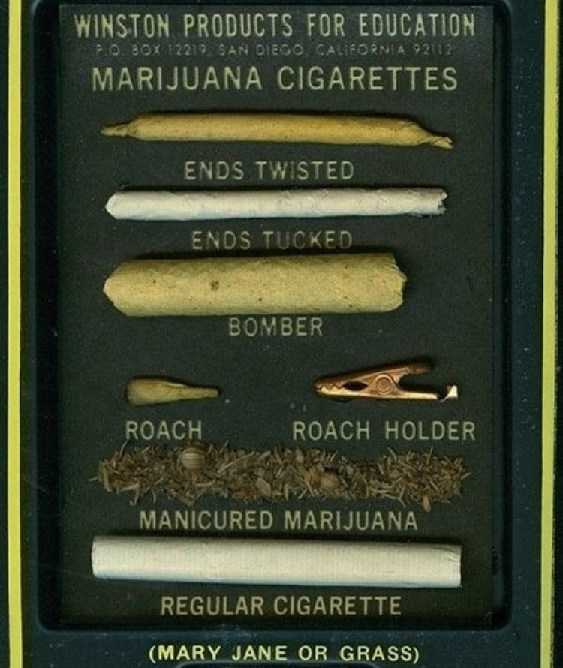
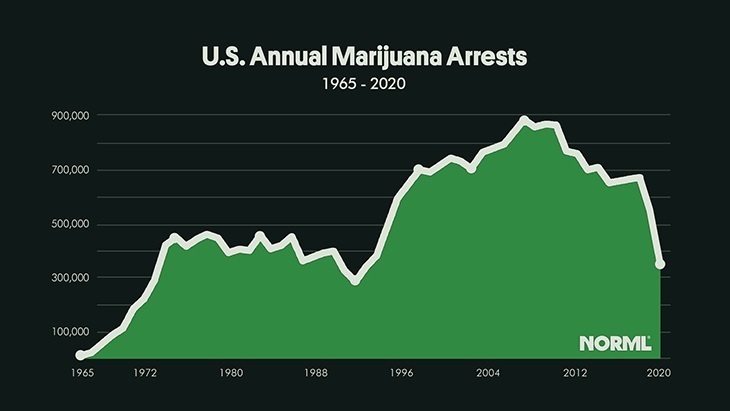
- 1969: FBI reports 98% increase in marijuana arrests from 1966 - 1968
Quote:
August 26 - FBI reports 98% increase in marijuana arrests from 1966 - 1968
(http://www.ronaldreaganweb.com/)

Edited by Learyfan (08/25/20 07:21 PM)
|


 Threaded
 Previous
 Index
Index Next
Next Injection Grain Bag
  Unfolding Nature: Being in the Implicate Order
 Learyfan


 California

 Brian Jones


 Edit
Edit  Reply
Reply 












 1 2 all )
 Learyfan
 PrisonSong
 freddurgan
 Newbie
 Bi0TeK
 Helge
Helge
 eligal